
When a local LLM beats an API, and when it doesn't
· 5 min read
Local LLM vs API compared: measured model sizes from 2 GB up, privacy tradeoffs, honest crossover math ($22.50/month test case), and which side fits you.
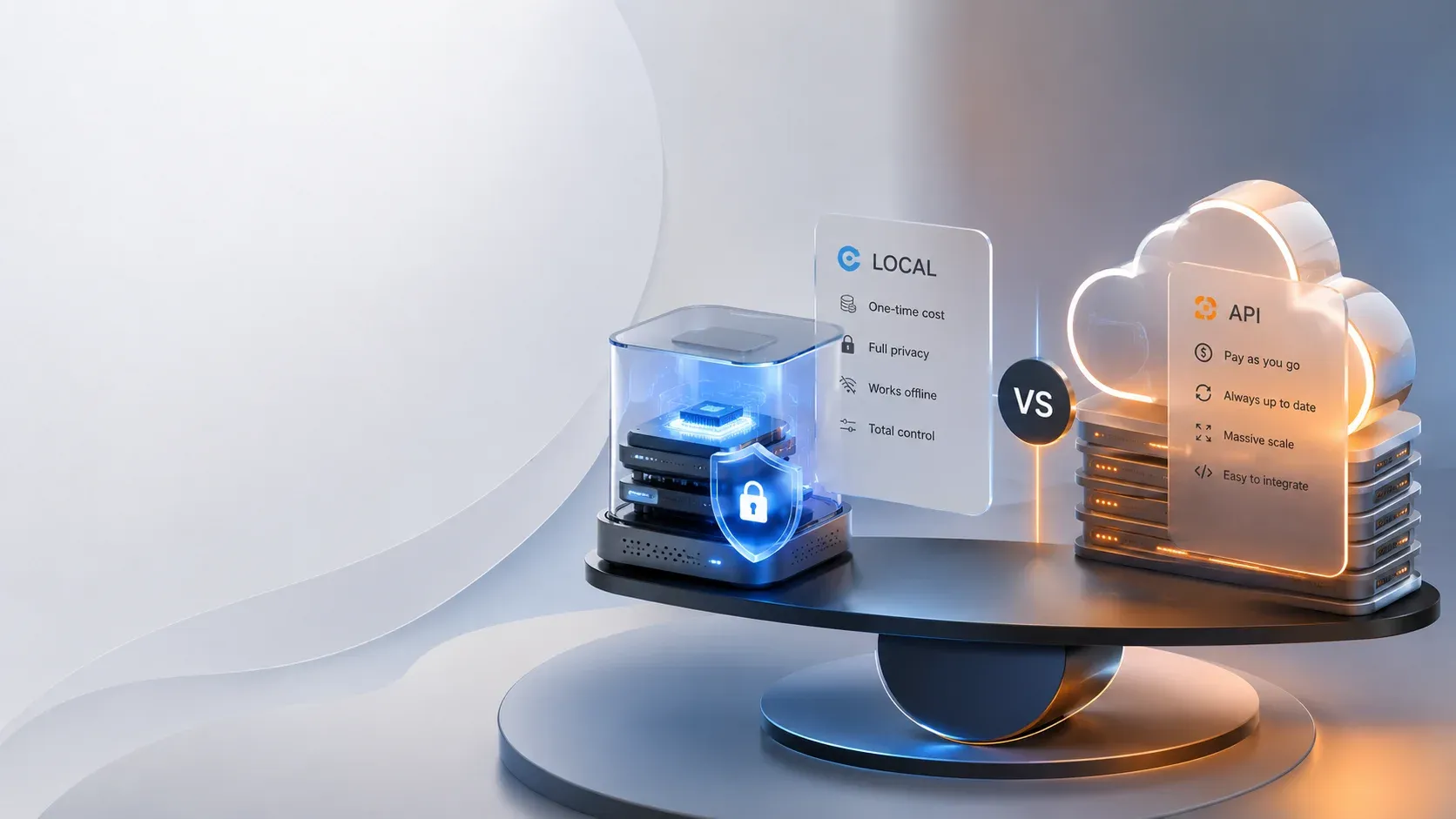
- Local models run on your hardware with zero per-token cost; APIs rent frontier quality
- A quantized 3B model fits in about 2 GB
- Sensitive data that must not leave the machine is the strongest local argument
- Frontier APIs still lead on hard reasoning and complex tool use, so most real setups end up running both sides together
The core trade: own the weights or rent the frontier
Running a local LLM means downloading model weights and executing inference on hardware you control. Calling an API means sending text to someone else's GPUs and paying per token. Everything else in this comparison cascades from those two sentences: local gives you permanence, privacy, and fixed costs in exchange for quality ceilings and setup work. APIs give you frontier-quality output and zero operations in exchange for recurring bills and data leaving the building.
What local looks like right now
The local tooling caught up. Ollama runs models behind a one-command interface, LM Studio wraps the same idea in a desktop app with a model browser, and llama.cpp remains the engine underneath much of it, executing quantized weights on laptops rather than datacenter cards.
How big are the downloads?
To make hardware requirements concrete instead of hand-wavy, we queried real file sizes from Hugging Face, where quantized weights are published:
| Quantization | File size (measured) |
|---|---|
| Q4_K_M GGUF | 2.02 GB |
| Q8_0 GGUF | 3.42 GB |
Both files ship from the model's repository ready to run on ordinary consumer machines: the smaller quantization targets laptops with integrated graphics, while the higher-fidelity one wants modest discrete VRAM. Scaling to 8B-class models raises the default Q4_K_M file to 4.92 GB, which fits inside an 8 GB graphics card once context memory is budgeted; 70B-class models enter workstation territory. The practical floor for useful general assistants sits around 3B parameters today, which would have sounded absurd two years ago.
What throughput do laptops get?
Throughput numbers ground the comparison. Benchmarks collected in the llama.cpp project's Apple Silicon thread decode a 7B model at 4-bit quantization at roughly 24 tokens per second on a base M4 chip and 14 on an original M1, comfortable reading pace for chat and drafting work. Hosted APIs typically beat those figures during bursts and respond with lower time-to-first-token on fast connections, though they degrade under provider load in ways local hardware never does.
What APIs provide that local cannot
APIs sell the top of the capability curve. Frontier models from Anthropic and OpenAI handle long-context reasoning, nuanced writing, and complex tool use that open weights of matching size do not reach yet, and each provider upgrade arrives without you buying RAM. Pricing scales per token with current rates listed on those pages, so costs track usage exactly: prototypes cost cents, production workloads negotiate volume commitments.
The operational side matters equally at scale. Providers absorb GPU provisioning, capacity spikes, model versioning, and safety filtering. A local deployment makes every one of those your problem, from driver updates to benchmarking whether a new release actually improved your use case.
Privacy: the argument that decides regulated work
Data sent to an API crosses organizational boundaries, lands in provider logs under contractual terms, and returns as text; most providers pledge no training on API inputs, but compliance teams read the fine print before architecture reviews conclude. Encryption in transit, the mechanism our SSL certificate guide explains, shields traffic from network observers yet never from the provider itself.
Local inference keeps bytes on the machine entirely: medical drafts, legal documents, source code under NDA, and personal data never traverse any network. For hospitals, law firms, defense-adjacent vendors, and anyone handling customer PII at scale, this single property frequently ends the debate regardless of quality gaps elsewhere.
The crossover question done honestly
Per-token pricing makes API costs scale linearly with usage, while local costs front-load into hardware then flatten near zero. Published rates make the math concrete: GPT-4o currently lists at $2.50 per million input tokens and $10 per million output tokens. A support bot drafting 5 million input plus 1 million output tokens monthly therefore runs about $22.50 per month, $270 a year.
A dedicated $900 machine pays itself back in roughly three years at that volume, before counting electricity; ten times that volume shortens payback to about four months.
Occasional light queries never justify any hardware purchase at all. Estimate your own workload first, then price it against whichever rate card applies to you. Beware both marketing directions here: free local is not free once your hours count, and API bills surprise teams whose product succeeds beyond forecasts.
The quality gap, stated plainly
Open weights, published continuously on Hugging Face, close distance yearly. Small models now handle summarization, extraction, classification, and straightforward coding competently. Hard tasks remain differentiators: multi-step agentic work, subtle instruction following across long contexts, and low-resource languages favor frontier APIs clearly enough that teams feel it immediately.
The pragmatic pattern emerging across the industry routes easy high-volume tasks locally and escalates genuinely hard requests to paid models, capturing most of each approach's benefits. For where hosted models still earn their keep day to day, our roundup of the best AI coding assistants covers the current field.
Choosing by situation
| Situation | Better fit |
|---|---|
| Regulated or confidential data | Local, almost always |
| Highest quality on hard reasoning | API |
| Air-gapped or offline environments | Local exclusively |
| Rapid prototyping without hardware | API |
| Very high-volume simple transforms | Local |
| Product features needing provider SLAs | API |
A portfolio, not a verdict
Local LLM versus API resolves into portfolio thinking: local owns privacy-critical and high-volume-simple workloads at flat cost, APIs own frontier-quality and bursty-demand workloads at variable cost, and the hybrid between them covers nearly everyone. Measure your real token volumes, try a 3B local model against your easiest task tonight since it downloads in minutes, and let the results argue rather than ideology.
Related Tools
Written by
Abhay Khant
Abhay Khant is the founder of ToolSura, a privacy-first developer tools platform. Writes about client-side architecture, AI tooling, and the open web.