
What your IP address reveals about you and your connection
· 6 min read
Your IP address explained: find it on any device, public versus private ranges, a live trace of what servers see, and why 4.3 billion IPv4 addresses ran out.
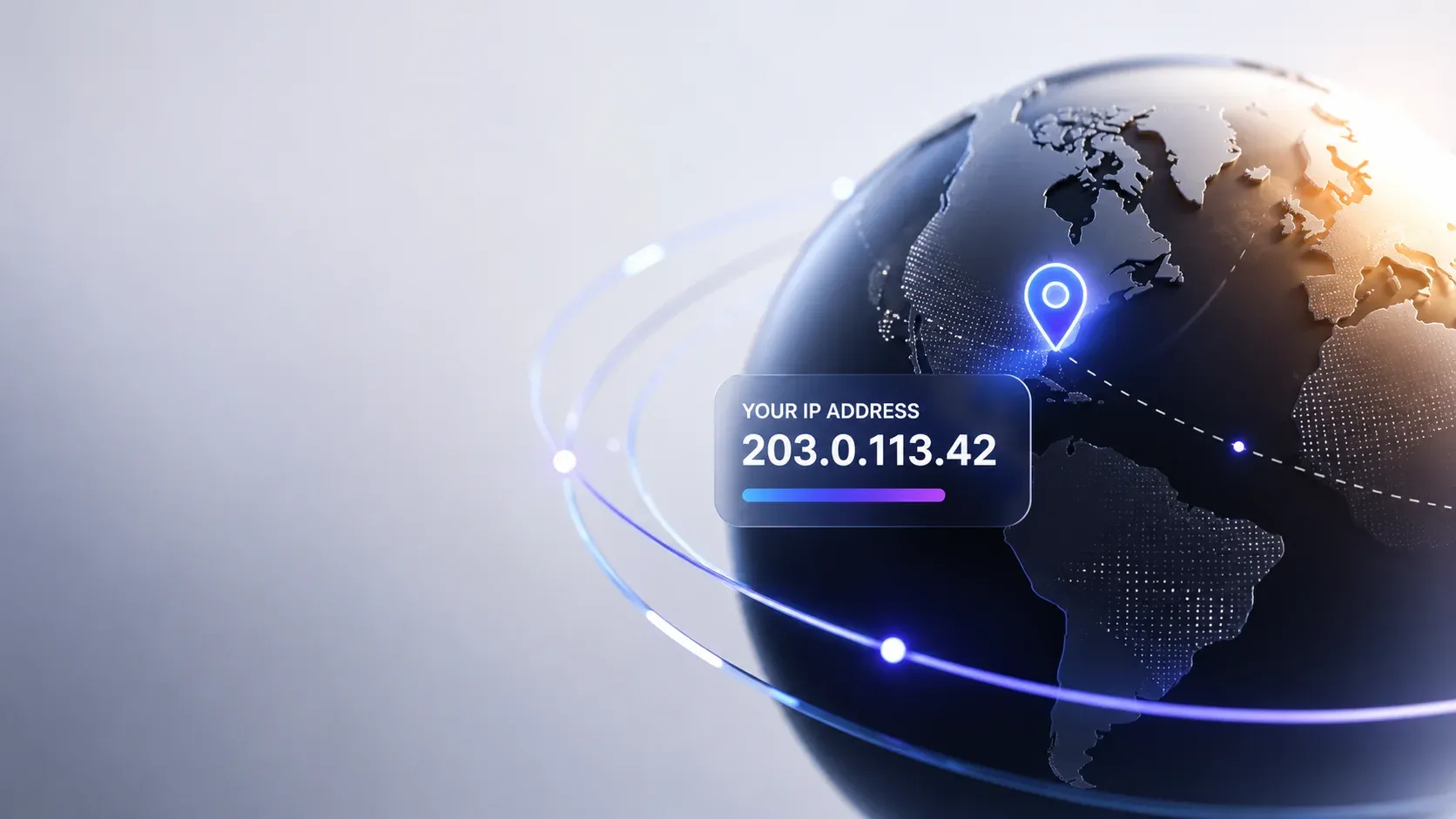
Every device that reaches the internet carries at least one address label, yet most people never see theirs unless something breaks. If you have ever typed "what is my IP address" into a search bar, this guide explains what you were actually looking up, how to find it on any device, and what websites learn from it.
- Your public IP is the return address servers see when your devices connect
- Private addresses like 192.168.x.x never leave your router; only the public one travels
- An IP reveals approximate location and provider, never a street address
- Websites can also see protocol details: we captured TLS 1.3 and HTTP/2 on a live trace
Background reading that stays accurate: Wikipedia's IP address overview, the IPv6 addressing plan in RFC 4291, and IANA's live IPv4 address-space registry.
What an IP address actually is
An IP address is the numeric label that identifies a device on a network using the Internet Protocol. Version 4, specified in RFC 791, writes it as four numbers from 0 to 255, such as 203.0.113.42. Version 6, defined in RFC 8200, expands the space into eight hexadecimal groups because four billion v4 addresses ran out years ago. Every packet crossing the internet carries these labels so replies know where to come back.
The distinction that matters most for everyday questions: your laptop usually holds a private address inside your local network while your router holds the public one visible to websites. When you search what is my IP, the useful answer is the public one.
Public versus private, precisely
RFC 1918 reserved three ranges for private networks: 10.0.0.0/8, 172.16.0.0/12, and 192.168.0.0/16. Millions of homes reuse those same numbers simultaneously because they are unroutable from outside; your router translates between them and the public internet with NAT, a mechanism RFC 2663 defines formally and the same RFC that reserved those ranges anticipated. The IANA special-purpose registry catalogs these plus other non-routable blocks such as 127.0.0.1 loopback.
| Clue | Meaning |
|---|---|
| Starts with 10., 172.16-31., or 192.168. | Private; internal to your network |
| Starts with 127. | Loopback; this machine itself |
| Anything else | Publicly routable; what websites see |
Finding your IP address on any device
Your public address appears the moment you ask any web service, so the fastest route is searching what is my IP or opening our IP lookup tool. Finding the private address your router assigned works differently per platform:
- Windows: open Command Prompt or PowerShell and run
ipconfig; the IPv4 Address line under your active adapter is your LAN address - macOS: System Settings, then Network; the connected interface shows its address in the details pane, or run
ifconfig en0in Terminal - iPhone and iPad: Settings, Wi-Fi, then tap the information button beside the connected network; the IP address field sits near the top
- Android: Settings, Network and internet, then the network's details panel lists the address alongside the gateway
- Your router's public side: many routers typically display the WAN address on their admin status page, reachable at 192.168.0.1 or 192.168.1.1
The distinction matters when debugging: if the router's WAN page and a what-is-my-IP site disagree, something between them, usually an ISP modem in bridge mode or carrier-grade NAT, is rewriting the visible address.
Static versus dynamic assignments
Most consumer connections use dynamic assignment through DHCP: the router leases local addresses for hours or days, while the ISP rotates the public address periodically. Server operators pay extra for static addresses precisely because DNS records, firewall rules, and allowlists assume stability. Neither kind is inherently better; dynamic assignment simply trades predictability for the provider's address-pool efficiency. One practical consequence: a rebooted router can present a different public address the same afternoon, which breaks naive IP-based authentication and surprises people mid-session.
What a website really sees: a live trace
To ground this in reality rather than description, we requested a diagnostic trace from Cloudflare's edge endpoint during research for this guide. The response carried fields including everything any web server observes about visitors:
ip=2409:40c1:..., an IPv6 address; we truncated the tail deliberately before quoting itloc=IN, country derived from geolocation databasescolo=BOM, the edge data center serving us, Mumbaitls=TLSv1.3andhttp=http/2, protocol capabilities of our connection
The same endpoint answers plain text for anyone curious about their own connection. Note what appeared without being asked: the network's protocol versions and coarse location ride along automatically. Also notice the address was IPv6 even though most people still assume four-dot numbers; mobile carriers hand out v6 natively under the IPv6 specification, and dual-stack connections expose whichever family the route prefers. The IP address lookup tool shows the equivalent view for any address you paste in, returning provider and geography context.
What an IP does and does not reveal
A public IP maps to an organization, typically an ISP or mobile carrier, and to a geographic region accurate at city or regional granularity under favorable conditions. It does not name a person or resolve to a house; the hop from region to customer sits inside provider records protected by legal process almost everywhere. Websites combine IPs with cookies, logins, and browser fingerprints to build better pictures than the IP alone provides, which is the honest framing: the address is one signal among several, weak on its own and meaningful mainly when aggregated.
Two modern wrinkles change old assumptions. Carrier-grade NAT means many households can share one public address. Logs that attribute activity to a single IP may therefore cover dozens of strangers. And rotating residential assignments mean yesterday's address may belong to someone else today, which is why abuse reports lean on timestamps matched against provider records.
VPNs, proxies, and the address you present
Routing traffic through a VPN replaces the public address websites see with the tunnel exit's address, moving your apparent location to wherever that server lives. Proxies behave similarly at application layers. Neither makes you untraceable; providers keep connection records, and fingerprinting correlates sessions across address changes. For the narrower goal of not broadcasting home-region context to every site visited, tunnels work as advertised, provided DNS requests follow the same path, a failure mode our DNS leak guide explains alongside its test. The off/on comparison makes the state visible in ten seconds: run an IP lookup with the tunnel disabled, note the address and country, enable the tunnel, and run it again. Matching values mean traffic is bypassing the tunnel; a foreign exit address means the presentation layer changed, even though your ISP still knows who you are.
Checking your own setup
- Look up the public address plus provider and geography context with the IP lookup tool
- Compare addresses with the VPN off and on; if both show identical values, traffic is bypassing the tunnel
- Confirm private ranges on local devices stay out of server logs by design
Three checks cover the whole surface: what the outside world sees, whether your tunnel actually routes, and whether local ranges stay local. Anything deeper belongs to firewall configuration rather than address literacy.
One label, limited secrets
That is the full answer to what is my IP address: your IP address is the internet's return label, essential for every connection, revealing about your network and rough geography, silent about your identity and precise place. Knowing how to find it, why phones show six-group v6 strings, and what tunnels change turns a mysterious number into ordinary plumbing you can inspect whenever debugging requires it.

Written by
Freya Sundby
I do the arithmetic in binary once and then convert, because the decimal form hides the boundary between the network part and the host part. The prefix length says how many leading bits belong to the network. So the network address clears every bit after the prefix and the broadcast address sets every one after it, and the usable range is what lies between. That is the whole of it, and every subnetting question reduces to counting bits.
The two addresses to exclude catch people out. A prefix of thirty leaves two addresses and no usable hosts. A prefix of thirty-one leaves one, which is a valid entry and almost never what was wanted. A prefix of thirty-two is a host route.
The classic question asks for the number of subnets and hosts, and the answer depends on which prefix length is in force, so the question has to state it. IPv6 is the same idea in a different shape. One hundred and twenty-eight bits written as eight groups of hexadecimal, with a rule that compresses a run of zero groups.
The default prefix on a single interface is sixty-four, which halves the address, and the subnetting question has a different answer because an allocation is large enough for a site. The transition has a piece that did not change: the routing table and the subnet mask mean the same thing in either family, and the arithmetic is identical once the width is fixed. Every tool that takes both has to be told which one it is looking at. I also cover what to do when a mask and a prefix disagree, which is to fix the configuration rather than to reason about it.