
Your worst index names your first fix
· 10 min read
Paste your draft, fix sentences first and words second, then re-score: a practical loop for getting more from a free readability checker.

Most writers open a readability checker, paste a draft, and stare at seven numbers going seven directions. The instinct is to fix whatever looks reddest, or to chase every dial down at once, and both waste the afternoon. There is a calmer way to read the panel: find the worst index, let it name the lever, and pull the levers in coefficient order. Sentences first, because every formula divides by them. Heavy words second, because syllable weight moves grades fast. Unfamiliar words third, and only near the Dale-Chall cliff where they matter. Then re-score and stop.
This guide walks that loop inside ToolSura's free readability checker: paste your draft, read the panel, split sentences first, swap flagged words second, trade unfamiliar words third, re-score, and know when to stop. If you want what the numbers mean, the companion piece on what a Flesch-Kincaid score actually predicts owns the theory. This post re-teaches zero formulas. Every constant below appears only as a lever coefficient: which fix moves which dial.
The revision loop in five steps
- Paste and read the panel. Paste a full section of prose, then find the worst index: it names your first lever.
- Split the longest sentences. One idea per sentence. The only fix that moves every index at once, so it always goes first.
- Swap flagged heavy words. Trade three-syllable words for shorter synonyms from a published table.
- Trade unfamiliar words for familiar ones, only near the 5% cliff. Below that line this lever barely moves anything, so it goes last.
- Re-score and read the delta, then stop. Score again after each lever, and stop when the worst index's own remedy is exhausted.
Step 1: paste into the readability checker and read the panel
Paste two or three whole paragraphs, not a single sentence. Each index counts something different, so the first job is triage: which index complains loudest? A high Flesch-Kincaid grade with a low Ease score means long sentences, heavy syllables, or both: levers one and two share the work. High Fog beside a calm FK means short sentences carrying one heavy word each: a targeted swap. High Dale-Chall alone means two or three off-list words pushed you over the 5% cliff. High Coleman-Liau or ARI alone means long spellings.
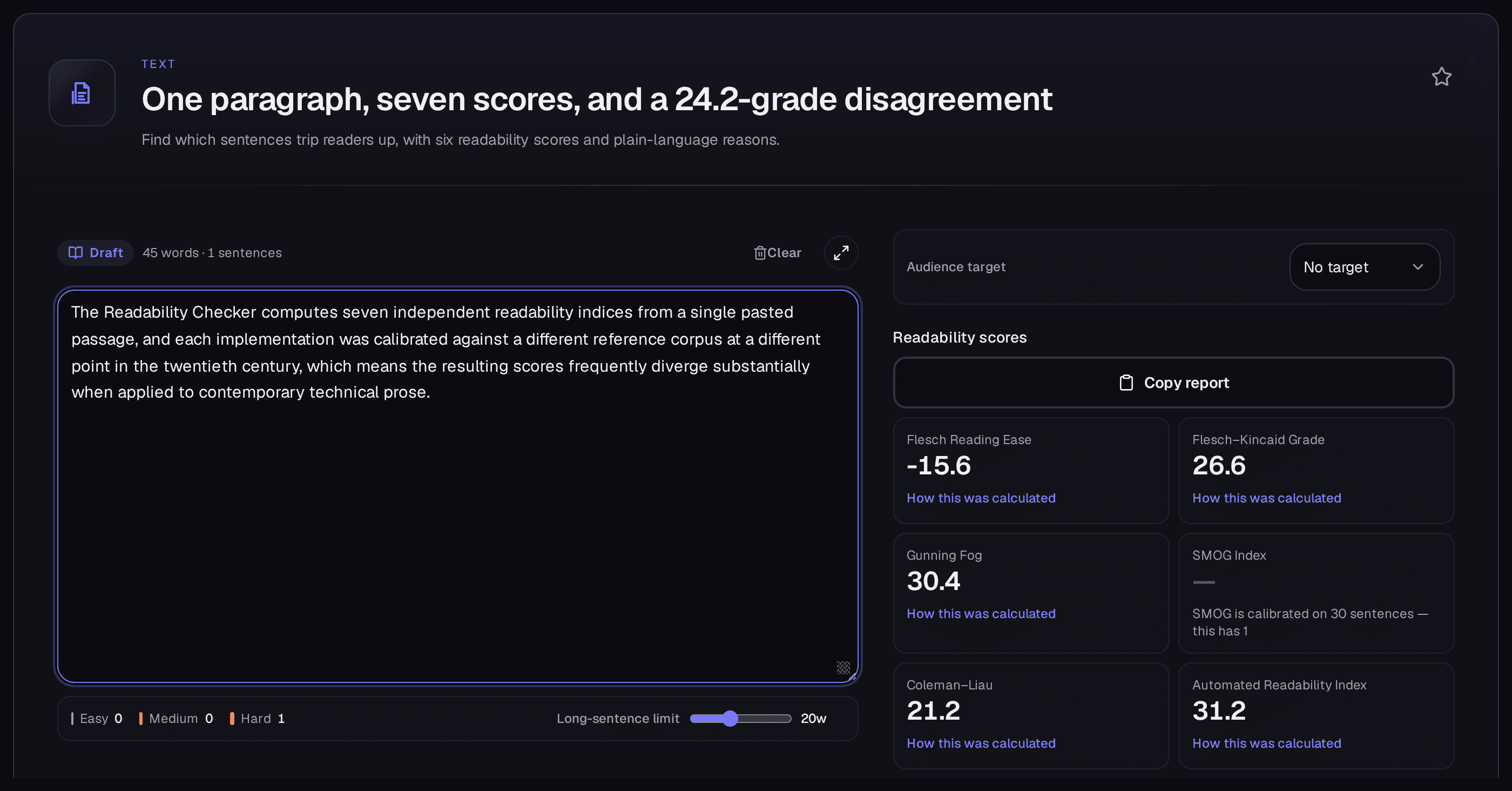
Score panel on this exact input: "The Readability Checker computes seven independent readability indices from a single pasted passage, and each implementation was calibrated against a different reference corpus at a different point in the twentieth century, which means the resulting scores frequently diverge substantially when applied to contemporary technical prose." Scores shown are the live tool's output for that input; the body quotes no panel numbers.
Two warnings before you touch a word. The panel's flags are candidates, not convictions: a highlighted term your readers know stays. And read the panel by behaviour, not implementation: highlighted sentences, flagged words, a delta against target.
Lever 1: split long sentences first, because the math touches everything
Average sentence length is the one quantity nearly every formula divides by, making splitting the highest-coefficient fix. The Flesch-Kincaid grade formula charges 0.39 per ASL word, Flesch Ease moves 1.015 points per ASL word, the Gunning Fog Index charges 0.4, ARI charges 0.5 per ASL word (carried constant), and Dale-Chall adds 0.0496 per ASL word. Halving ASL from 20 to 10 cuts roughly 3.9 grades off FK, 4.0 off Fog, and adds about 10 Ease points. No other fix moves four dials at once.
The published advice frames the fix around ideas rather than lengths. The archived federal guideline on writing short sentences says to express only one idea in each sentence: break the idea into its parts and make each one the subject of its own sentence. (Those guidelines now live archived in the GSA plainlanguage.gov repo, mirrored from plainlanguage.gov.) Take each highlighted sentence, find its ideas, and give each its own sentence, joined by a plain "but" or "so" where needed.
The sentence-length slider is a lens, not an edit: it surfaces more flags, and nothing changes until you split a sentence and re-score. Splitting is not dumbing down: the first cut is coefficient order, because ASL moves every formula at once.
Lever 2: swap flagged heavy words for short, familiar ones
Once sentences are short, the remaining grade lives inside the words. The grade formula charges 11.8 per unit of average syllables per word, while Ease charges 84.6, so word swaps move Ease roughly seven times harder than grade. Dropping ASW from 2.0 to 1.6 cuts about 4.7 FK grades and adds about 34 Ease points. Fog charges 0.4 per complex-word point, so one heavy word removed from a 20-word sentence cuts roughly 2 Fog grades.
Work from a published substitution table, not instinct. The archived guideline on using simple words and phrases says to pick the familiar word over the obscure: facilitate to help, terminate to end, numerous to many, purchase to buy, require to need, "in order to" to "to," "due to the fact that" to "since."
Read each flag before accepting it. Fog's published method excludes proper nouns, familiar jargon, compounds, and common suffixes like -es, -ed, and -ing, per the Fog definition page, but whether the shipped counter applies those exclusions is UNVERIFIED. A product name or a term your field defines precisely may be flagged while being exactly the word your reader expects. Keep those, swap the rest, then re-score.
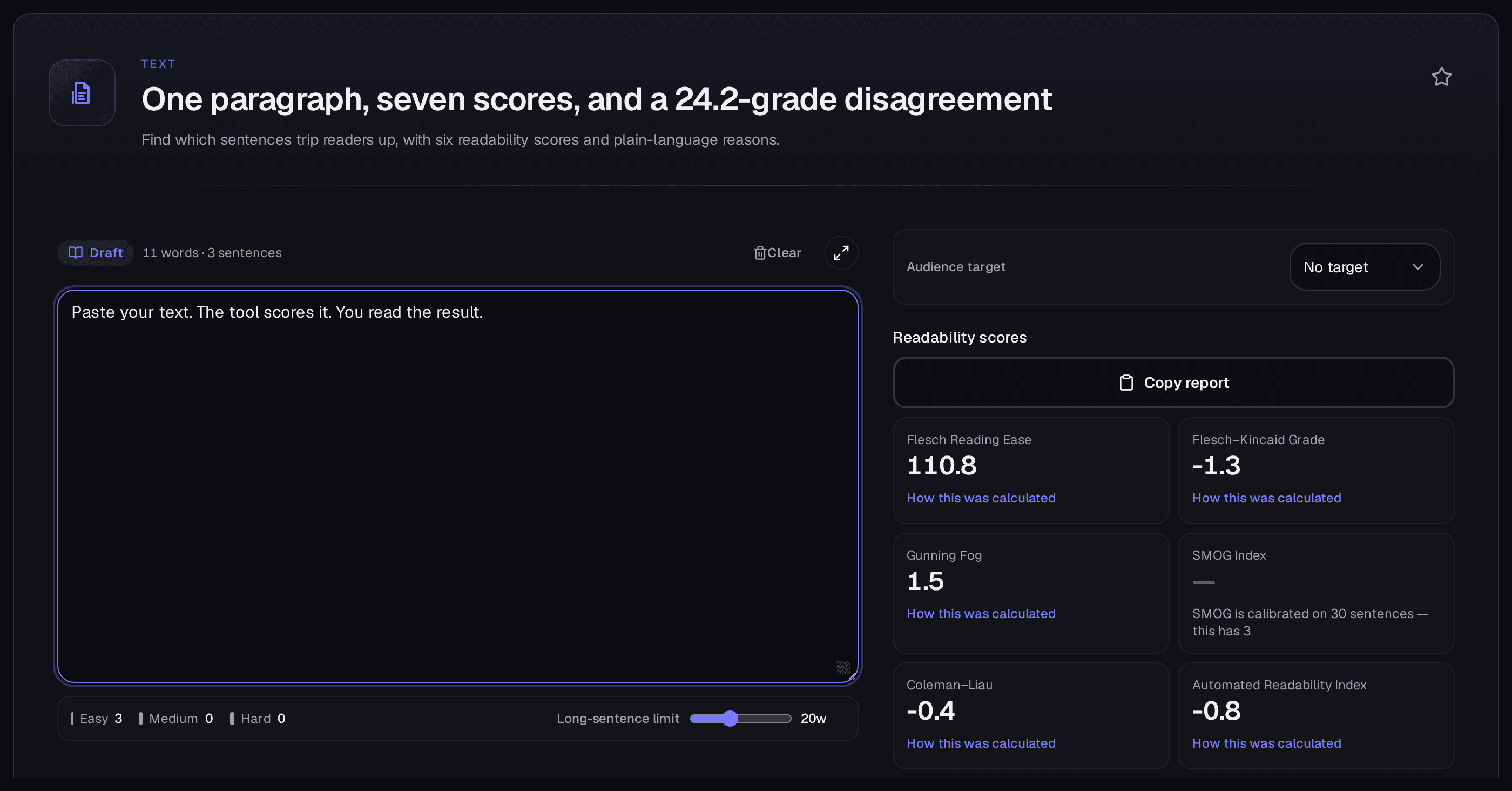
Contrast capture on this exact input: "Paste your text. The tool scores it. You read the result." Three sentences, light verbs, nothing to bill: the direction every lever pulls.
Lever 3: familiar words only count near the 5% cliff, and spellings last
Dale-Chall does not count syllables or letters; it counts unfamiliarity. Any word outside its list of 3,000 words that fourth-grade American students reliably understand counts as difficult, per the Dale-Chall formula page: raw score is 0.1579 times the difficult-word percentage plus 0.0496 times ASL, and strictly above 5% difficult, add 3.6365. (The tool codes the boundary as 5% or more; the two rules differ only at exactly 5.0%.) Dragging difficult words from 8% to 4% cuts roughly 4.3 grades, most of it the lost cliff penalty, but below 5% the same swaps buy almost nothing. If it is not your worst index, skip this lever.
Letter-weight is the smallest lever. Coleman-Liau charges 0.0588 per letter-per-100-words and ARI charges 4.71 per characters-per-word (both carried constants), so long spellings and abbreviations are what these two bill. Trim spellings only when one of them is your worst index.
The plain-rewrite payoff: what the loop buys
Folded together, the three levers turn dense prose plain without losing its point. The capture below scores a sixteen-word plain sentence about the tool itself: one idea, light words, every term familiar. Each split follows an idea boundary, so the result reads calmer, not chopped.
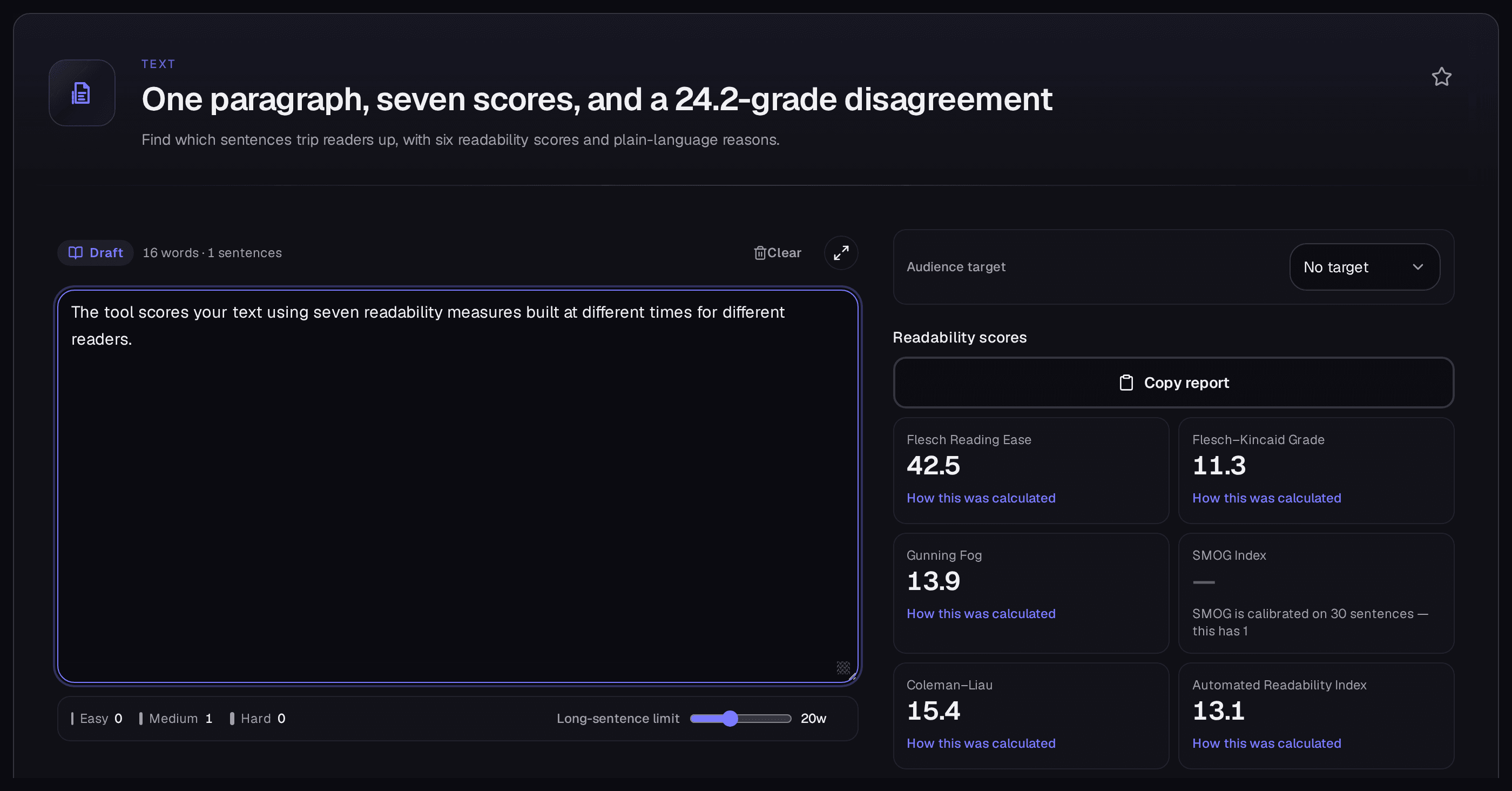
Payoff capture on this exact input: "The tool scores your text using seven readability measures built at different times for different readers." Sixteen words, one sentence, plain diction throughout.
The loop in miniature: one sentence revised by hand, three stages
The following example is hand-computed, not tool output: every syllable count is stated so you can check the arithmetic, and the tool's pinned syllable library may count edge -ed words differently, shifting short-text grades either way by about half a point. It paraphrases rather than preserving meaning on the final swap: an arithmetic illustration of lever order, not style advice.
Dense v0: "The implementation facilitates extensive modernization of system operations." Eight words, one sentence, ASL 8.0. Syllables stated: The 1, implementation 5, facilitates 4, extensive 3, modernization 5, of 1, system 2, operations 4, totalling 25, ASW 3.125. FK equals 0.39 times 8.0 plus 11.8 times 3.125 minus 15.59, which is 3.12 plus 36.875 minus 15.59, giving FK 24.4. Fog: five of eight words carry three or more syllables, 62.5%, so 0.4 times the sum of 8 and 62.5 gives Fog 28.2.
Split only, lever one: "The implementation facilitates extensive modernization. It improves system operations." Nine words, two sentences, ASL 4.5. Syllables 18 plus 9, totalling 27, ASW 3.0. FK equals 0.39 times 4.5 plus 11.8 times 3.0 minus 15.59, which is 1.755 plus 35.4 minus 15.59, giving FK 21.6. Splitting alone bought 2.8 grades; the heavy words still dominate.
Swapped, lever two: "We improved the system. It now works faster." Eight words, two sentences, ASL 4.0. Syllables 6 plus 5, totalling 11, ASW 1.375. FK equals 0.39 times 4.0 plus 11.8 times 1.375 minus 15.59: 1.56 plus 16.225 minus 15.59, giving FK 2.2. Fog: no complex words remain, so 0.4 times 4.0 gives Fog 1.6. "Improved" counts as 2 syllables here, with the -ed sounded; the tool's library may count it differently.
The lesson in one line: splitting moved FK 3 grades, word swaps moved it ~19, because ASW started at 3.1 and was saturated. On normal prose the gap narrows, but the order holds: split first, because it is free and it moves every index.
Passive voice: the flag is mechanical, the decision is style
Treat the passive flag as two separate questions. The mechanical one is what the construction costs your averages. A passive adds a "to be" auxiliary plus a past participle, the two forms the active-voice guideline names, and often a "by" phrase: typically one to three extra words per clause. In a single-sentence 20-word passage, two extra words raise ASL by 2, adding 0.78 to FK, 0.8 to Fog, and subtracting about 2 Ease points. Heavy participles ("authorized," "implemented") add syllable weight on top. The flag matters to the math only through word and syllable counts, so a short passive like "It was done" barely moves anything.
The style question belongs to you, with both sides on the record. The guideline calls passive "one of the biggest problems with government writing" because active voice "makes it clear who is supposed to do what" while passive "obscures who is responsible for what." Purdue's guide to choosing passive voice answers that writers in the sciences conventionally use passive more often, and it fits when the agent is obvious, unimportant, or unknown. This post prescribes nothing universal. The tool flags, the author decides: name the actor where responsibility matters ("The company polluted the lake"), keep the passive where the agent is unknown or your genre expects it. The detection pattern is UNVERIFIED: judge the sentence, not the highlighting.
When to stop re-running the readability checker
Revising without a stop rule converges on mush: short, flat sentences that score beautifully and say nothing. Four rules mark "done."
Diminishing returns are structural. Gains shrink because the averages floor out: ASL cannot fall below 1.0, average syllables cannot fall below 1.0, complex share cannot fall below zero. Past an ASL around 8 to 10, further splitting buys tenths per cut while breaking discourse flow. The guideline frames the fix as one idea per sentence: ideas, not fragments. When every sentence carries one idea, lever one is finished.
Voice and score pull opposite ways. Fog's own limitations page warns that "interesting" scores as complex without being difficult, while short rare words score as simple without being easy, and the index is primarily built for English. Technical terms inflate scores honestly; your readers may know them anyway. The score predicts years of schooling needed on first reading; it is not a grade on the writer. What the numbers mean lives in the Flesch-Kincaid explainer.
Genre sets the floor, and only published fit-points count. Readability formulas were built for schoolbooks and neglect reader differences, content, layout, and retrieval aids, so a methods section full of conventional passives will never read at grade 8 and should not try. The published fit-points: Fog under 12 for a wide audience and under 8 for near-universal understanding; Flesch 60 to 70 for plain English at eighth-to-ninth level and 50 to 60 for tenth-to-twelfth; Dale-Chall from 4.9-and-under material for the early grades up to 9.0 and above for college level. Anything finer, any house number picked below these bands, is an invented threshold.
Run the which-ruler stop test. FK or Ease still high after swaps means sentences are still long: lever one is undone. Fog high but FK calm means one heavy word per short sentence: a targeted swap. Dale-Chall high alone means two or three off-list words above the cliff: lever three, then done. CL or ARI high alone means long spellings: lever four, then done. SMOG declined on fewer than 30 sentences is a refusal: never pad a draft to thirty sentences to force a number out of it.
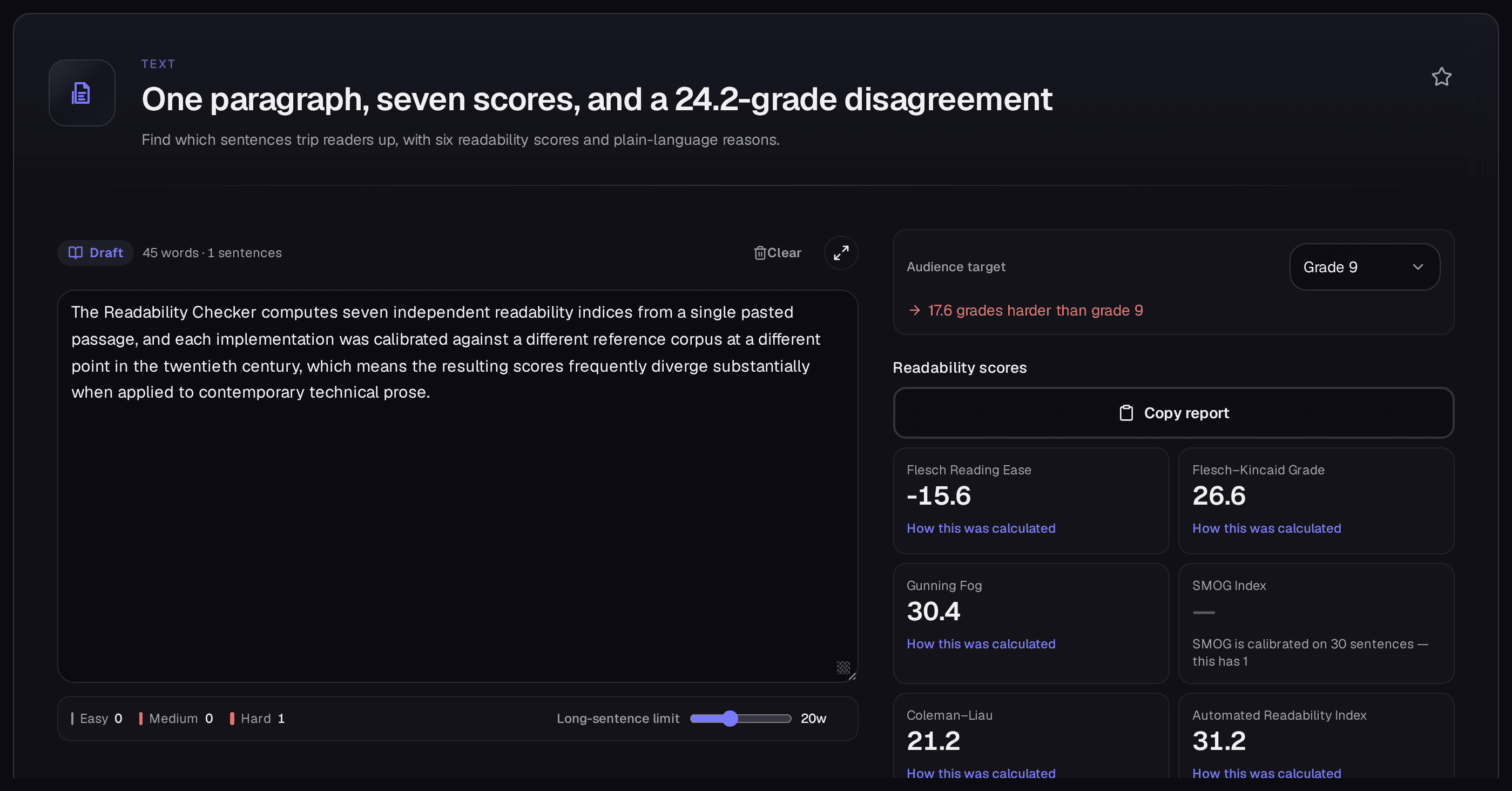
Target capture on the hard-passage input quoted under the first screenshot, with the audience-target control set to Grade 9. Read the delta as distance, not quality; the target itself should come from the published fit-points above.
Limits: short texts, odd shapes, quoted terms, English prose, drifting counters
Small samples misbehave. SMOG refuses passages under 30 sentences; that gate is carried from the explainer's research. The roughly five-word floor under Flesch scores is tool behaviour, not a formula requirement: tool guidance, never law. Fog's method assumes full paragraphs of around a hundred words and full sentences, so bullet lists, headings, tables, and code inflate ASL unpredictably; paste prose, because lists score oddly, and this tool's exact splitting behaviour is UNVERIFIED. Quoted terms inflate scores honestly; keep what your reader knows. Non-English prose is out of scope: Fog is primarily built for English, SMOG lacks statistical validity off English (carried), and this tool's non-English behaviour is UNVERIFIED. Syllable counters drift: edge words counted two ways move every syllable-billed index without a prose change, so compare scores only within one tool version, and record the index, the tool, and the date with every number.
Related Tools & Further Reading
- Free readability checker — paste your draft and run the loop: split, swap, re-score, stop.
- What a Flesch-Kincaid score actually predicts — the theory companion: formulas and why indices disagree.
- How many sentences sit in a paragraph — sentence count is the input every formula shares, so paragraph convention sets the ASL your loop starts from.
- Free word counter — quick counts before you score, when you need a tally, not a grade.

Written by
Colette Marchand
A readability score is a prompt to look at a paragraph, and nothing more. Some count syllables because syllable count correlates with difficulty. Some count sentence length, which is the easiest thing to measure and the least reliable.
Some count the proportion of words that are not common. That last one depends entirely on which word list is used, so two tools with the same formula and different lists give different numbers on identical text. Syllable counting is the weak link in the widely used formulas, because counting syllables in English is ambiguous at the end of a word and in loanwords. Every formula that uses it carries that error forward. Formula choice changes the grade by several years on the same paragraph, so a score means nothing without the formula named.
I put that on every page. What the score cannot see is the main limitation. It has no notion of whether the sentence is a heading, a caption, a table cell or a paragraph of explanation, and it treats all of them alike. A technical page scores badly and reads well to the audience that needs it.
What I recommend instead is reading the paragraph aloud and checking whether anything needs unpicking, which is slower and considerably more accurate. Where a score has to be reported, I report the formula, the word list and the sentence it scored, so the number can be reproduced or dismissed rather than taken on trust. A score also rewards short sentences mechanically, which pushes writing towards choppy prose that scores well and reads badly. That is the clearest demonstration that the number is a rough instrument.