
A grade level predicts schooling, not good writing
· 8 min read
What a Flesch-Kincaid score means: US grade level from sentence length and syllables, why rival indices disagree, and what no grade can say.

Grade 8.3. The number sits under your draft like a verdict, precise to a decimal place, yet it answers a question nobody asked: 8.3 what? A Flesch-Kincaid score predicts the years of US schooling a reader needs to understand your passage on first reading. Grade 8.3 means a typical eighth-grader could follow it, nothing about whether the writing is good, true, or right for your reader.
That single sentence dissolves most arguments about the number. A grade level is a prediction about schooling, not a measurement of quality, and every readability index disagrees with every other by design, because each counts something different. Syllables, letters, heavy words, unfamiliar words: same passage, five different rulers. Once you see which ruler your tool picked up, the mystery numbers turn into arithmetic you can check by hand. No statistics background needed, since counting words in a sentence is the whole audit.
What a Flesch-Kincaid grade level actually predicts
The claim is modest. The Flesch-Kincaid Grade Level formula presents its result as a US grade level: the years of education generally required to understand the text, once past grade 10. The Gunning Fog Index agrees: it estimates the years of formal education needed to understand the text on the first reading. Cold comprehension, not study.
The formula has a paper trail. The Flesch-Kincaid grade level was developed under contract to the US Navy in 1975 by J. Peter Kincaid and his team, then adopted by the Army in 1978 for judging technical manuals before becoming a US Military Standard. Pennsylvania wrote it into law first, capping automobile insurance policies at ninth-grade level as measured by the formula. (The 1975 Navy report is cited here via its reference entry; the original was not read directly.)
The scale comes with anchors: 90–100 reads at 5th-grade level for an average 11-year-old; 60–70 is plain English for 13- to 15-year-olds; 0–30 is college-graduate territory. And the scale has no ceiling (the formula's construction gives it no upper bound) while the theoretical floor sits at −3.40 for the four one-word sentences "Go. See. Stop. Rest." A negative grade is arithmetic, not an error state.
How the number is built, in four steps
Every formula below is average sentence length times something, plus something: the four steps never change, only the "something" does.
- Count three things. Split the passage into words and sentences, then count syllables. The worked example below uses two sentences and ten words.
- Divide into two averages. Average sentence length (ASL) is words divided by sentences. Average syllables per word (ASW) is syllables divided by words. These two averages are the entire input to the Flesch family.
- Weight and combine. The Flesch-Kincaid grade is
0.39 × ASL + 11.8 × ASW − 15.59, leaning on sentence length over word length. Its sibling, Flesch Reading Ease, is206.835 − 1.015 × ASL − 84.6 × ASW. Heavy polysyllabic words move Ease far more than they move the grade. - Read the result as a grade. The output corresponds with a US grade level. No hidden curve, no percentile table.
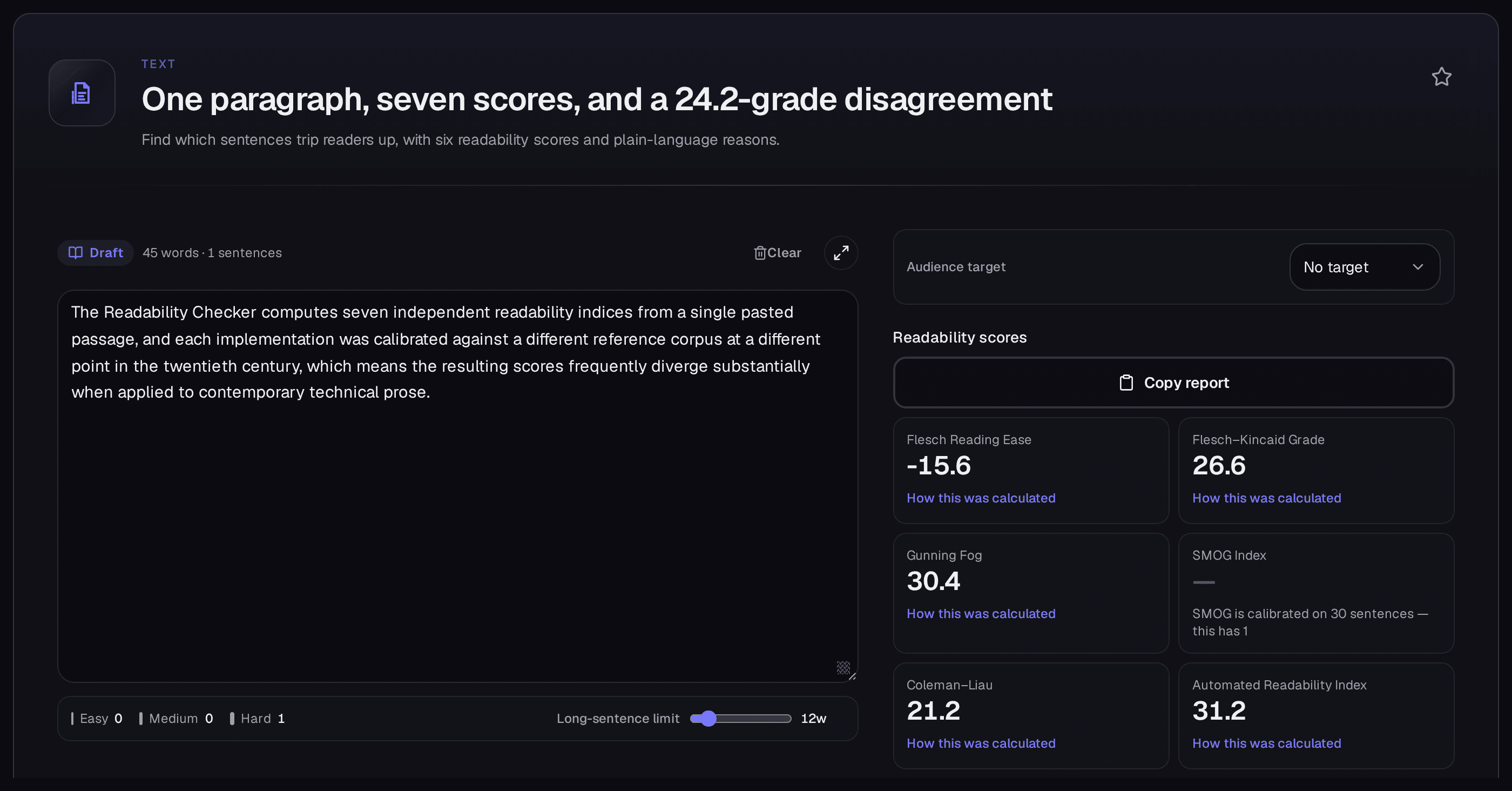
Same passage, five different rulers
Each index takes sentence length and pairs it with its own idea of word weight:
| Index | What it counts | Formula | What moves it |
|---|---|---|---|
| Flesch Reading Ease | ASL + syllables per word | 206.835 − 1.015·ASL − 84.6·ASW | Longer sentences and heavier words push it DOWN. Polysyllables hit it harder than they hit FK. |
| Flesch-Kincaid Grade | ASL + syllables per word | 0.39·ASL + 11.8·ASW − 15.59 | Leans on sentence length over word length. Result reads as a US grade. |
| Gunning Fog | ASL + share of complex (3+ syllable) words | 0.4·(ASL + 100·complex share) | One long word in a short sentence swings it. Skips proper nouns, jargon, compounds, and suffixes like -es, -ed, -ing. |
| Coleman-Liau | Letters per 100 words + sentences per 100 words | 0.0588·L − 0.296·S − 15.8 | Counts SPELLINGS, not sounds: characters, which machines tally far more reliably. |
| ARI | Characters per word + words per sentence | 4.71·chars/words + 0.5·ASL − 21.43 | Same character-counting family as Coleman-Liau. Published scores always round UP, so 10.1 prints as 11. |
| SMOG | Count of polysyllables (3+ syllables) | 1.0430·√(polysyllables × 30/sentences) + 3.1291 | Only the long-word count matters. Calibrated on 30-sentence samples and refuses shorter texts. |
| Dale-Chall | Share of words OFF a familiar-word list + ASL | 0.1579·PDW + 0.0496·ASL, plus 3.6365 when difficult-word share sits above 5% | The only index that asks whether fourth-graders have seen the word. A short rare word punishes DC and stays invisible to FK. |
FK and Flesch hear words (syllables), Coleman-Liau and ARI measure them (letters), Fog counts the heavy ones, Dale-Chall checks IDs against a list, and SMOG counts the heavy ones but demands 30 sentences first. The Coleman-Liau reference states the mechanism outright, and the ARI reference notes the index was built for real-time monitoring on electric typewriters, which is why it counts what a machine can see. ReadabilityFormulas prints the same constants, so the arithmetic below is checkable from more than one shelf.
Ten words, two grades: disagreement computed by hand
The proof, worked by hand (a hand-computed illustration, not tool output):
"Dogs bark loudly every morning. They chase squirrels in parks."
Counts, all checkable: 10 words, 2 sentences, so ASL is 5.0. Syllables run dogs 1, bark 1, loud-ly 2, ev-ery 2, morn-ing 2, they 1, chase 1, squir-rels 2, in 1, parks 1, 14 in total, so ASW is 1.4. Letters run 4 + 4 + 6 + 5 + 7 + 4 + 5 + 9 + 2 + 5 = 51, giving L = 510 per hundred words and S = 20 sentences per hundred words. Complex (3+ syllable) words: zero.
- FK = 0.39(5.0) + 11.8(1.4) − 15.59 = 1.95 + 16.52 − 15.59 = 2.9
- Flesch = 206.835 − 1.015(5.0) − 84.6(1.4) = 206.835 − 5.075 − 118.44 = 83.3 (Easy, in the 6th-grade band)
- Fog = 0.4 × 5.0 = 2.0 (no complex words, so the second term is 0)
- Coleman-Liau = 0.0588(510) − 0.296(20) − 15.8 = 29.99 − 5.92 − 15.8 = 8.3
- Dale-Chall, approximately: every word here plausibly sits on the familiar list, so difficult-word share is near 0 and the raw score is about 0.0496(5.0) ≈ 0.2 with no +3.6365, inside the 4.9-or-lower band
The headline: FK 2.9 against Coleman-Liau 8.3 on the same ten words, a 5.4-grade gap from nothing but the ruler. "Squirrels" explains it: 9 letters but 2 syllables, so the character ruler reads grade 8 while the syllable ruler reads grade 3.
One honesty hook: "every" is 2 syllables (ev-ery) to most counters but 3 to naive vowel-counters sounding out e-ve-ry, the same word, different counts, which is why scores drift between tools (see the last section). Run your own text through the readability checker and watch all seven rulers measure it at once, in your browser.
On one dial, up means easy; on the other, up means hard
The most common misreading is directional. On Flesch Reading Ease, higher means easier, roughly 0–100, with degenerate all-one-syllable passages reaching 121.22. On Flesch-Kincaid Grade, higher means harder: grade 12 demands more schooling than grade 6. Same passage, two dials, opposite directions.
So "higher is better" has no place here: there is no good or bad grade, only fit. A grade-6 consent form patients understand beats a grade-12 one nobody finishes. The useful question is never "is 9.2 good?" but "who must understand this on first reading?" Answer that, and the number becomes a target instead of a verdict.
Grade 12 does not mean a twelfth-grader wrote it
The mirror myth is authorship: that a grade level describes the writer, the quality, or the truth of the passage. It describes none of those. The formulas were built for school books. They neglect differences between readers and ignore content, layout, and retrieval aids. A grade level names a calibration point, not a reader.
Make it concrete: a grade-8 page in 9px grey type with no headings can be less readable than a grade-12 page with clear headings and a summary box, and no formula above sees any of that. Type, diagrams, and what the reader already knows all sit outside every equation. The plain language guidelines make the same point from the writer's side: match the text to the reader, because the number cannot see them.
The refuser and the list-checker
SMOG is the refuser. Its formula (grade = 1.0430 × √(polysyllables × 30 / sentences) + 3.1291) was normed on 30-sentence samples, and the SMOG reference calls tables for shorter texts statistically invalid. The checker honours this: below 30 sentences it declines SMOG and says so in the tile. The tool refuses, and the published formula backs the refusal. One stakes note, via the same tertiary reference: a 2010 study in the Journal of the Royal College of Physicians of Edinburgh judged SMOG the preferred measure for consumer healthcare material, background reading you can chase through the National Library of Medicine's index.
Dale-Chall is the list-checker: every word is judged against 3,000 words that fourth-grade American students could reliably understand, with anything off the list counted difficult. The list began as 769 words in 1948 and grew to 3,000 in 1995. The trap is the two versions: the 1948 raw score is 0.1579 × (difficult words / words × 100) + 0.0496 × (words / sentences), and the adjusted score adds 3.6365 only when difficult-word share sits above 5%. Otherwise adjusted equals raw. Name which one you show. Bands run 4.9 or lower (fourth grade and below) through 9.0 and above (college). Footnote: the shipped tool applies +3.6365 at 5% and above, while the published rule says "above 5%", they differ only at exactly 5.0%. The Dale-Chall reference carries the published wording.
Why your score moved when your prose did not
First the reassurance, measured 2026-10-12: the live checker is deterministic. The same 561-character passage in two fresh browsers gave byte-identical inputs and identical scores: FK 13.8, Fog 17.7, Coleman-Liau 19.4, Dale-Chall 6.1. Same bytes in, same numbers out. The methodology lesson: an earlier probe differed because fast typing had dropped characters. The inputs were never equal, so the outputs differed. Input inequality, not tool flakiness. That is why every number here carries its provenance: hand-computed or measured, always labelled.
Still, scores shift between tools and versions. The most likely mechanism (likely, not certain) is the syllable counter. Counting syllables is heuristic: dictionary and vowel-cluster counters disagree on edge words ("every" as 2 vs 3, "optimized" with or without the sounded -ed), so a new counter or library version moves FK, Flesch, Fog, and SMOG without touching your prose. The shipped engine pins one syllable library, deterministic per version, but a version bump can shift your FK by a point. Compare scores only within the same tool version.
Three more tool behaviours, each labelled as behaviour rather than published law. The checker warns on Flesch-family scores below roughly five words, tool behaviour only, since no published minimum exists for Flesch or FK. Its ARI prints one decimal while the published rule rounds non-integers up. And non-English input: the engine has script detection, but what the tool does with non-English text is UNVERIFIED. The indices were built and normed for English, with SMOG explicitly lacking cross-language validity, so scores on other languages stay UNVERIFIED too.
A grade level is a reason to re-read one sentence, not a verdict on your writing. Pick the sentence your reader meets first, run it through the readability checker, and ask whether its length and its words are doing the same job.
Related Tools & Further Reading
- Readability Checker — the payoff for this post: paste your text and watch all seven indices score it at once, entirely in your browser.
- Why Seven Readability Scores Disagree on One Paragraph — the sequel to this explainer: what happens when all seven rulers measure one passage side by side.
- How Many Sentences in a Paragraph — sentence count is the one input every formula shares, so paragraph convention decides what ASL your score starts from.
- Word Counter — the lighter next step for word, sentence, and basic readability counts across a whole document.

Written by
Colette Marchand
A readability score is a prompt to look at a paragraph, and nothing more. Some count syllables because syllable count correlates with difficulty. Some count sentence length, which is the easiest thing to measure and the least reliable.
Some count the proportion of words that are not common. That last one depends entirely on which word list is used, so two tools with the same formula and different lists give different numbers on identical text. Syllable counting is the weak link in the widely used formulas, because counting syllables in English is ambiguous at the end of a word and in loanwords. Every formula that uses it carries that error forward. Formula choice changes the grade by several years on the same paragraph, so a score means nothing without the formula named.
I put that on every page. What the score cannot see is the main limitation. It has no notion of whether the sentence is a heading, a caption, a table cell or a paragraph of explanation, and it treats all of them alike. A technical page scores badly and reads well to the audience that needs it.
What I recommend instead is reading the paragraph aloud and checking whether anything needs unpicking, which is slower and considerably more accurate. Where a score has to be reported, I report the formula, the word list and the sentence it scored, so the number can be reproduced or dismissed rather than taken on trust. A score also rewards short sentences mechanically, which pushes writing towards choppy prose that scores well and reads badly. That is the clearest demonstration that the number is a rough instrument.