
Where Markdown wins and where HTML is the better pick
· 4 min read
Markdown vs HTML compared with real measurements: rendered HTML ran 23% heavier than source, plus capability tables, safety notes, and when each format fits.
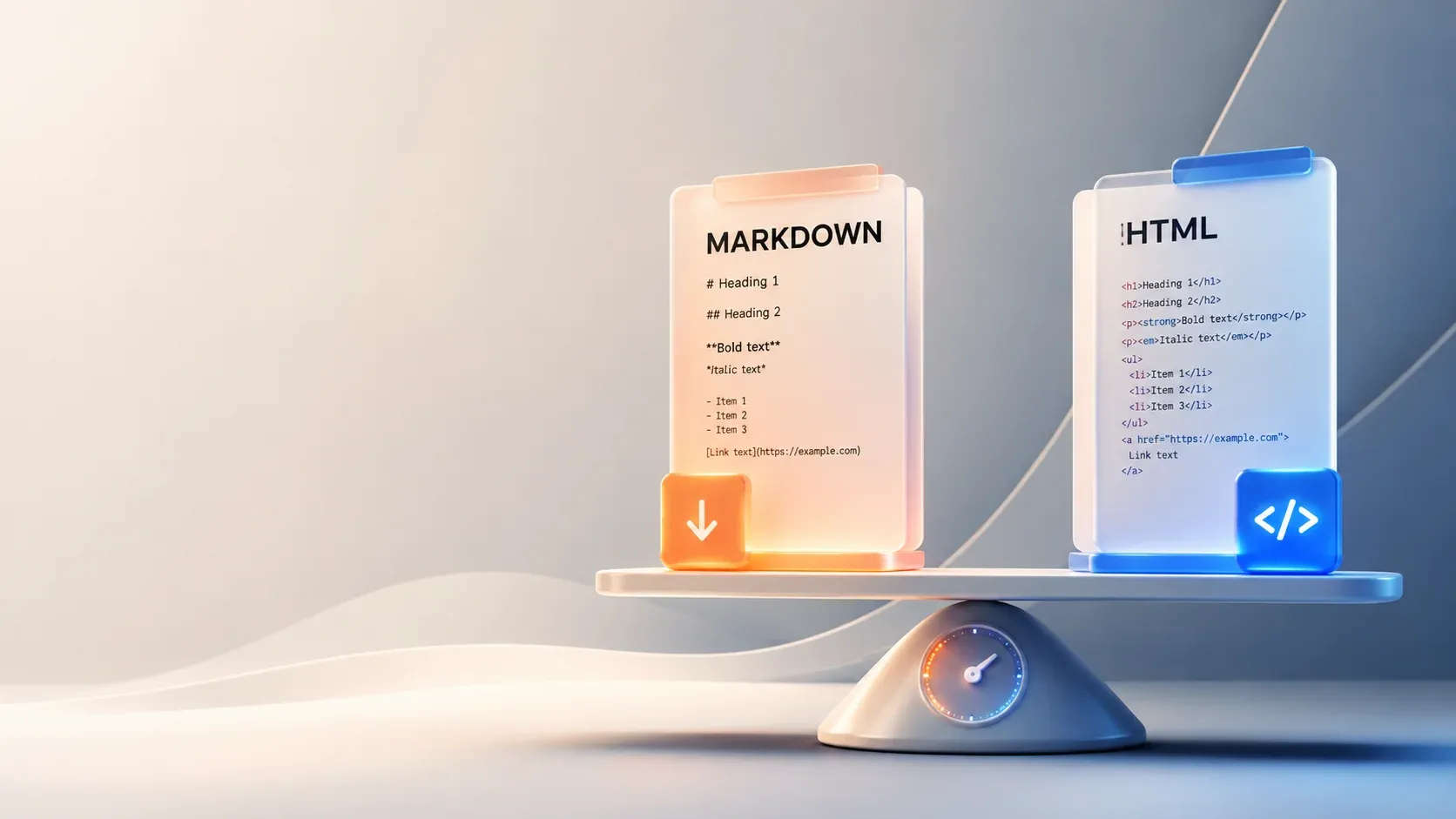
- Markdown is a writing format that converts to HTML; HTML is the web's rendering language
- We converted a real document: rendered HTML weighed about a third more than its source
- Write in Markdown wherever humans maintain prose; render to HTML for browsers
- HTML wins whenever behavior matters: forms, media controls, semantics beyond text
The core difference: source versus target
Markdown versus HTML is not a contest between rivals; Markdown was designed explicitly to be converted into HTML. Markdown is a lightweight syntax optimized for human writing and reading: asterisks make emphasis, hashes make headings. HTML is the markup language browsers actually render, defined across more than a hundred elements covering everything from tables to embedded applications.
To quantify the verbosity claim, we wrote a realistic 190-word quarterly-review document in Markdown and rendered it with Python's markdown library: 1,141 bytes of source produced 1,398 bytes of HTML, about 23% heavier from tags alone. Ratios vary by document, but the pattern holds; Markdown strips structure down to punctuation that reads well even unrendered, which is precisely why READMEs, forums, and note-taking apps standardized on it per the format's history on Wikipedia.
Markdown vs HTML: side-by-side comparison
The same content in both languages:
## Ship log
- **Status:** on track
- **Owner:** platform team
renders as:
<h2>Ship log</h2>
<ul>
<li><strong>Status:</strong> on track</li>
<li><strong>Owner:</strong> platform team</li>
</ul>| Dimension | Markdown | HTML |
|---|---|---|
| Purpose | Writing prose quickly | Describing documents to browsers |
| Readability raw | Near-plain-text | Tag-heavy |
| Coverage | Text basics only | Forms, media, semantics, apps |
| Standardization | CommonMark spec plus dialects | W3C/WHATWG living standard |
| Maintenance by writers | Comfortable | Rarely hand-edited |
When Markdown is the right tool
- Documentation, READMEs, and knowledge bases where engineers maintain text
- Blog pipelines where authors write and templates render
- Comments and chat systems needing safe, limited formatting
- Any workflow where non-developers must edit without breaking markup
The safety angle matters as much as ergonomics: Markdown cannot express scripts or arbitrary attributes, so accepting user input as Markdown sidesteps entire classes of injection bugs that raw HTML input invites. Convert once server-side and sanitize the result, the pattern OWASP's XSS guidance recommends for untrusted input; the Markdown to HTML converter demonstrates the transformation instantly, while the sanitizer tool shows what dangerous fragments look like when raw HTML slips through.
When you need full HTML
Whenever behavior or precise semantics enter the picture, Markdown's vocabulary ends. Forms collect input; video and audio embed with controls; tables need spanning cells and captions beyond Markdown's simple grid; accessibility depends on landmark elements Markdown cannot name; and metadata like language attributes lives only in HTML. Email templates, landing pages, and application interfaces are HTML-native domains where prose syntax cannot follow; our guide to testing HTML email rendering covers the trickiest of these. Forcing Markdown into those contexts adds a lossy layer for no benefit.
A practical combined workflow
- Draft content in Markdown for speed and portability
- Convert to HTML at build time or render time, never maintaining both by hand
- Lint the source for consistency with the Markdown linter before publishing
- Extend with raw HTML blocks sparingly where Markdown falls short, exactly the escape hatch the GFM specification formalizes
Draft in our Markdown to HTML converter, sanity-check output in the HTML live preview, and let one conversion direction stay canonical. Converter choice matters less than people fear: cmark, markdown-it, and pandoc all track the same spec, but round-tripping is lossy in every direction. HTML back to Markdown drops attributes, tables degrade, and footnotes vanish, so treat Markdown as the editable source of record and regenerate HTML rather than maintaining both.
Write in one, ship in the other
Markdown vs HTML resolves into division of labor: Markdown for humans drafting prose, HTML for machines presenting pages. They cooperate rather than compete, a relationship the original Markdown project stated in its founding goals, and nearly every modern publishing pipeline uses both in sequence. Choose Markdown when writers own the words, full HTML when browsers own the behavior, and let a converter bridge them.
Related Tools
Written by
Abhay Khant
Abhay Khant is the founder of ToolSura, a privacy-first developer tools platform. Writes about client-side architecture, AI tooling, and the open web.