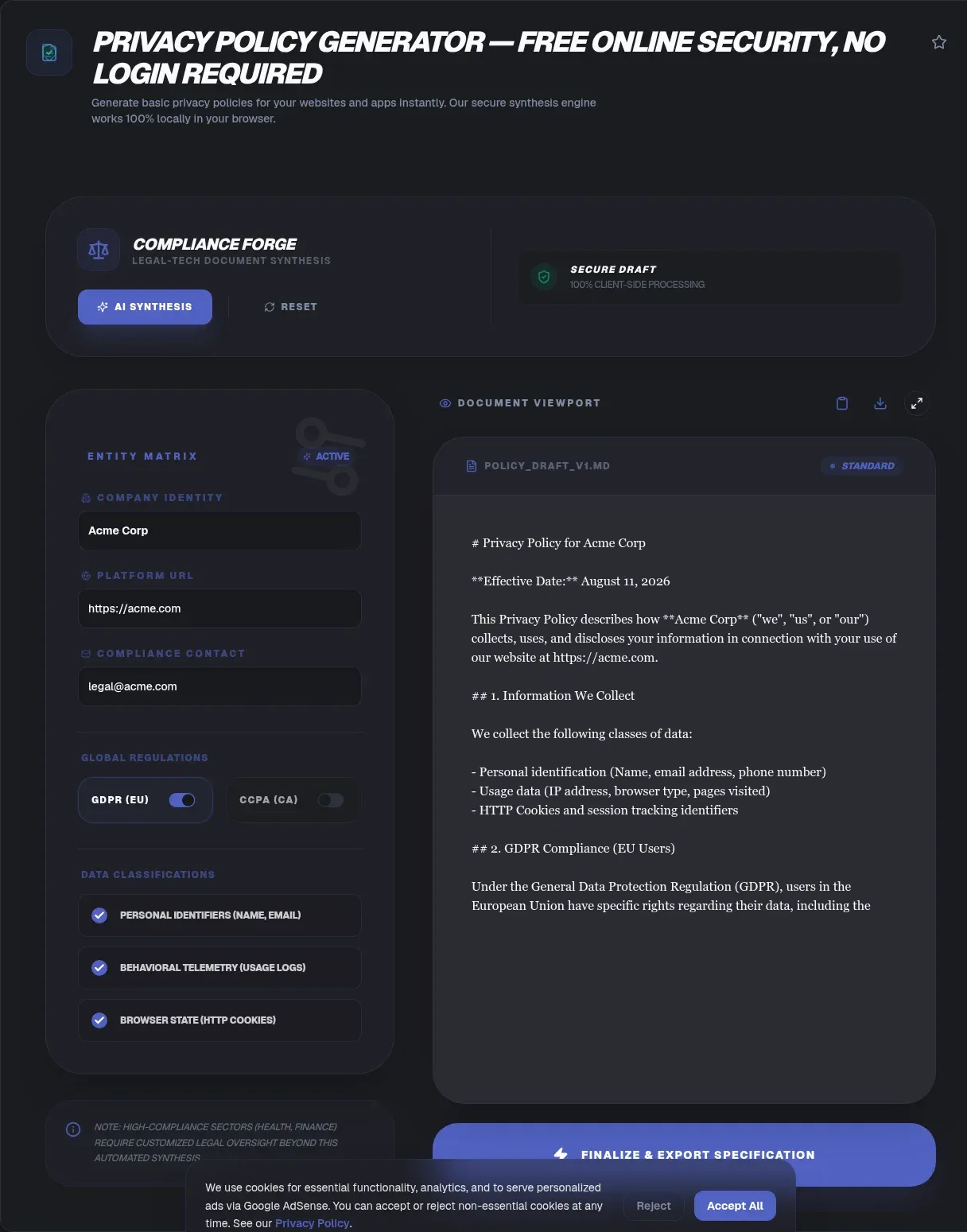
The ToolSura Privacy Policy Generator turns structured answers about your data practices into a customized policy draft, ready to download as HTML, plain text, or PDF per its documentation Source. You describe who you are and what you collect; the tool assembles the disclosures those facts require.
One framing note before anything else, because this page does not carry an explicit disclaimer of its own: a generated policy is drafting assistance, not legal advice. Nothing produced from templates can guarantee compliance with any law; treat output as a strong first document that professionals should review before it carries your organization's name.
What a Privacy Policy Actually Promises
A privacy policy is a public accounting of promises: what personal data you collect, why, how long you keep it, who else receives it, and what rights people hold over it. Under the GDPR, controllers must clearly disclose collection, declare the lawful basis and purpose for processing, state retention periods, and identify sharing with third parties or transfers outside the EEA Source.
Those duties explain why generic placeholder policies fail. Every promise in the document must match operational reality: if your form collects phone numbers but the policy lists only emails, the document is inaccurate on day one regardless of how well written it reads.
Why These Rules Reach Almost Everyone
The GDPR's reach extends past Europe's borders. Wikipedia notes it applies not only when organizations are based in the EU but also to organizations anywhere that collect or process personal data of people located inside the EU, including when offering goods or services or monitoring behavior there under Article 3(2) Source.
A blog in one country with European readers therefore falls inside scope for its analytics and comment data. Enforcement carries real weight too: fines scale to 10 million euros or 2 percent of annual worldwide turnover at the lower tier, doubling to 20 million or 4 percent at the higher tier, whichever figure is greater Source.
What This Generator Asks
The tool structures intake around the questions regulators ask anyway, per its documentation: whether you operate as an individual, company, or non-profit; which data types you collect such as names, email addresses, or IP addresses; collection methods spanning forms, cookies, and third-party services like Google Analytics; purposes from marketing to analytics; third-party sharing arrangements; and contact details for privacy inquiries Source.
That structure matters more than any wording the generator produces. Answering precisely forces the inventory exercise every honest policy requires, surfacing practices teams themselves forget exist until asked.
The Rights Section, Done Properly
GDPR notices must inform people of their rights, and Wikipedia enumerates them concretely: revoking consent at any time, viewing and accessing held data, obtaining a portable copy, erasure under certain circumstances, contesting automated decisions, and filing complaints with a Data Protection Authority Source. Controller contact details and designated DPO information belong there too where applicable.
The generator claims tailored sections covering user rights and DPO contact fields per its FAQ Source. Verify each listed right survived customization with your specifics intact, since rights language is exactly where template drift causes real problems during complaints.
CCPA and Platform Requirements
Alongside the GDPR, the page references California's Consumer Privacy Act among the regulations its output addresses Source. State-level statutes carry their own disclosure obligations and thresholds; verify current requirements against official sources rather than assuming template coverage suffices.
Platform rules add independent pressure. Per the tool's FAQ, Google AdSense participation requires disclosing vendor cookies, and mobile distribution through app stores involves policy-link requirements in listings Source. Distribution choices create documentation duties even where no statute would have forced one.
Templates Versus Legal Advice
Here is the honest center of this topic. Generators solve the blank-page problem and encode common structural expectations; they cannot know your actual data flows, vendor contracts, retention schedules, or jurisdictional exposure. The tool's own caveat makes the same point: legal compliance depends on specific practices, so drafts need review against reality Source.
For personal projects, a carefully completed draft reviewed against your forms and scripts may suffice. For businesses handling meaningful volumes of personal data, professional review is not optional caution but basic diligence, given fine regimes measured in percentages of turnover. Budget accordingly and sleep better. The generator earns its keep by making that professional review fast and focused on judgment rather than formatting, which is precisely where expert hours deserve to go.
Keeping Policies Current
Policies rot silently whenever practice drifts ahead of publication: new analytics vendors, added newsletter integrations, changed retention windows. The page advises reviewing drafts against actual practices regularly and updating as laws change Source.
Institutionalize the habit rather than trusting memory. Whenever shipping a feature touching personal data, update the policy in the same change cycle, and schedule a periodic full read-through annually. Timestamps on updates also serve transparency, showing visitors the document lives rather than lingers.
Where Policies Live
Publication placement follows discoverability expectations: a public URL linked from site footers, referenced wherever collection happens, and embedded in store listings for apps per the platform-requirement claims above Source.
Format flexibility helps here. The tool's download options span HTML for direct embedding plus plain text and PDF for contexts like app-store attachments or contractual exhibits Source, letting one source document feed every destination without manual reformatting.
Working Through the Generator
Prepare answers before opening the form: list every data type collected across every surface, name each third-party processor, decide retention periods, and designate a contact. Ten minutes of inventory produces dramatically better output than improvised responses.
Then edit the generated result against reality line by line. Delete sections describing practices you do not have; add anything unique to your operation; confirm the contact address reaches someone who will actually answer privacy requests. The finished document should read like your organization wrote it deliberately, because after editing, it did.
Publish with provenance too: keep the dated source file alongside the deployed page, note which generator version and answers produced it, and record who approved publication. Six months later, when a regulator inquiry or partner questionnaire arrives, that provenance trail answers questions about what was promised and when without archaeology.
A Pre-Generation Inventory Checklist
Ten minutes of preparation upgrades output quality dramatically, so gather these facts before touching the form. Every personal data type collected anywhere on the property, including fields teams forget such as IP addresses in logs. Every vendor touching that data, from analytics to email delivery to advertising networks.
Retention periods per category, even approximate ones you intend to shorten later. The lawful basis you rely on for each processing purpose where GDPR applies. A working contact address that reaches someone accountable for privacy requests. Your organizational form, since individual operators, companies, and non-profits carry different disclosures Source.
Answering honestly at inventory time is also a self-audit: practices nobody wants to write down are usually practices someone should question.
Key Takeaways
- A policy is enforceable promises about collection, purposes, retention, sharing, and user rights.
- GDPR transparency duties reach organizations worldwide that serve EU visitors, backed by fines up to 4 percent of global turnover.
- Generated drafts solve structure and blanks; accuracy depends entirely on matching your real practices.
- Platform rules like AdSense cookie disclosures impose policy duties beyond statute.
- Review output professionally before consequential use, then revisit whenever practices change.
Frequently Asked Questions
Does my small website really need a privacy policy?
Likely yes on two independent grounds. GDPR duties apply to organizations outside the EU that process data of people inside it, which covers most sites with analytics or comments serving European visitors. Platforms stack their own requirements atop statute: the tool page notes AdSense participation demands disclosing vendor cookies, for example.
Is a generated privacy policy legally sufficient?
Treat it as a customized first draft rather than finished legal work. The generator cannot know your true data flows, contracts, or retention habits; its own documentation warns that compliance depends on your specific practices. For anything consequential, professional legal review converts a good template into a defensible document.
What must a GDPR-compliant notice disclose?
Per the regulation's documented duties: what data is collected, the lawful basis and purpose for processing, retention periods, third-party sharing including transfers outside the EEA, and any solely automated decision-making. Notices must also enumerate user rights covering access, portability, erasure, consent revocation, and complaints, alongside controller and DPO contact details.
What are the GDPR fine levels?
Two tiers apply under Article 83: up to 10 million euros or 2 percent of annual worldwide turnover, whichever is greater, at the lower level, rising to 20 million euros or 4 percent of worldwide turnover for graver violations. Those ceilings make accurate policies a financial matter, not merely a courtesy.
How often should I update my policy?
Whenever a practice changes materially, add a vendor, alter retention, launch a feature collecting something new, and periodically regardless, since laws evolve. The tool's guidance says as much, advising regular review against actual practices. An annual full read-through paired with per-feature updates keeps the document honest without becoming a chore.
Do app stores require privacy policy links?
Per the tool page, both Google Play and the App Store involve policy-link requirements for listings, making documents mandatory infrastructure for mobile distribution rather than website-only formalities. Generate once in HTML, keep text and PDF variants current, and reference the same canonical URL everywhere to avoid version drift.
Does the generator store the answers I provide?
Its documentation describes fully local processing with zero data transmission to servers and no account requirement, though such statements remain operator self-descriptions. Standard caution applies to business-sensitive configurations regardless: keep unusual processing details generic until you trust any tool's handling with your specifics.
Related Tools
Support the surrounding compliance work:
- Word Counter fits summaries into listing fields.
- JSON Formatter & Validator checks consent-config payloads.
- HTML Entity Encoder/Decoder fixes characters in embeds.
- URL Encoder/Decoder tames tracking parameters.
- IP Address Lookup informs regional scope analysis.
- Timestamp Converter tracks revision timelines.
Turn blank-page dread into a working draft at the Privacy Policy Generator and answer the questions regulators will ask anyway.
One final practice separates maintained policies from abandoned ones: version the document visibly. Number your revisions, summarize what changed between versions in a short changelog section, and date every update. Visitors gain confidence seeing a living commitment, and your own team gains a reference when questions arise about exactly which promises applied on which dates.
Regulators themselves reward visible governance. Enforcement actions consistently document whether organizations knew their obligations, maintained current disclosures, and responded to requests promptly. A dated, accurate, actively maintained policy is evidence in your favor before any conversation begins, while a stale one undermines every other compliance investment you have made.