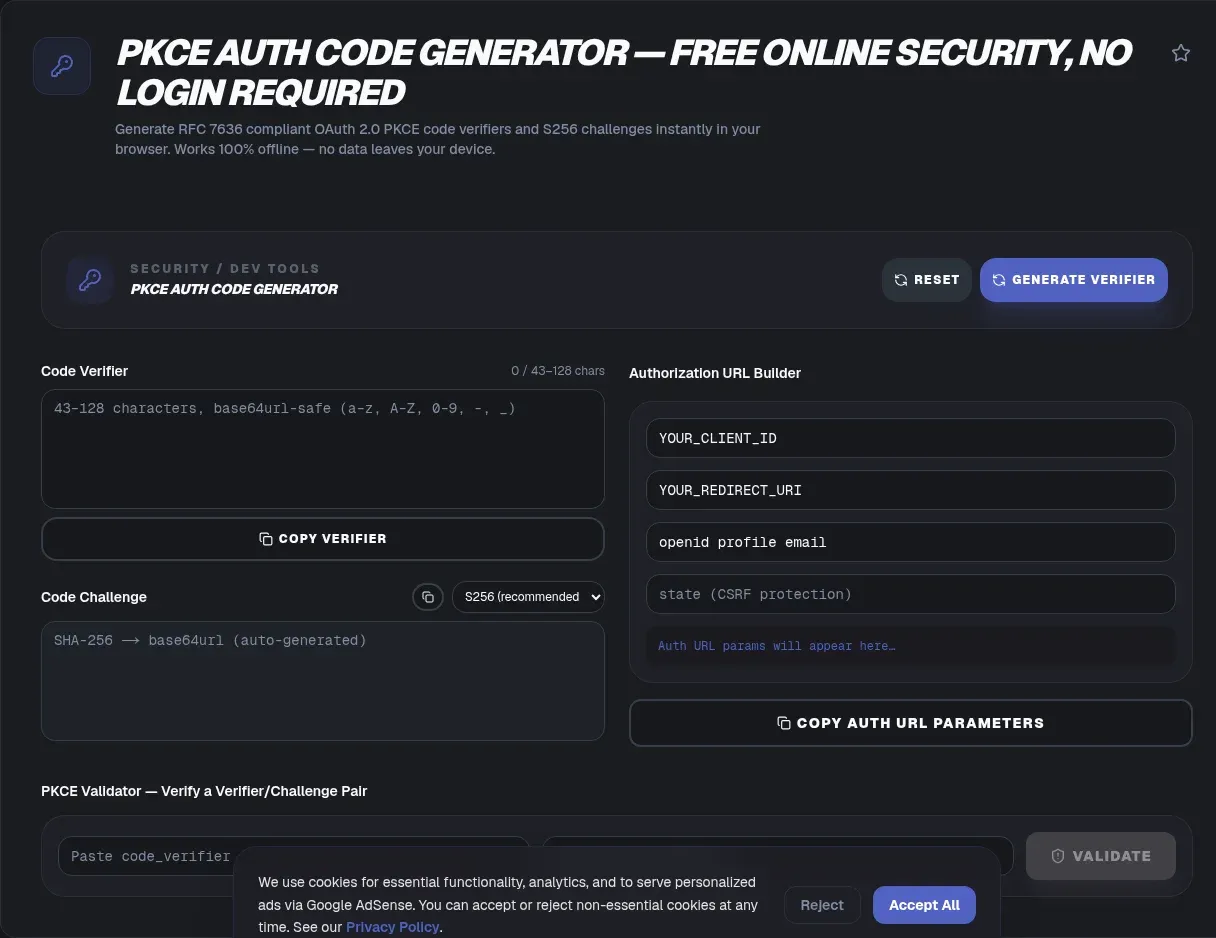
The ToolSura PKCE Generator produces cryptographically secure code_verifier and code_challenge pairs for OAuth 2.0 authorization flows entirely in your browser. Generation draws randomness from the platform's cryptographic random number generator and derives S256 challenges through native SHA-256 hashing, per the tool's documentation Source.
The page describes fully local processing with no cookies, analytics, or tracking, and notes it works offline once loaded, including inside air-gapped environments Source. That locality is not a luxury here: the verifier this tool creates is itself a secret, so generating it anywhere remote would undermine the property it exists to provide.
What PKCE Protects Against
PKCE answers one specific attack. Public clients such as mobile apps and single-page applications cannot hold secrets safely, so an attacker who intercepts their authorization code could otherwise redeem it at the token endpoint pretending to be the legitimate app.
RFC 7636 names this threat the authorization code interception attack and introduces PKCE as its mitigation Source. The defense works by binding the code to a secret the interceptor never sees: whoever requests the authorization must later prove possession of a random phrase that traveled only as a hash during the request phase.
The Verifier-Challenge Pair Explained
The mechanism reads like a password handshake between your app and itself across time. Your application generates a random secret phrase called the code_verifier, then computes a hash-derived fingerprint called the code_challenge and sends only that fingerprint with the initial authorization request.
At the token exchange, the original verifier finally travels to the token endpoint, where the server hashes it and compares against the earlier challenge. A match proves the party redeeming the code is the same party that started the flow. An intercepted code alone is useless, because the challenge cannot be reversed into the verifier that satisfies it.
Why S256 and Never Plain
Two challenge methods exist, and only one belongs in modern deployments. The plain method transmits the verifier value itself during the authorize step, offering protection only against the most naive interception timing. The S256 method sends BASE64URL-ENCODE(SHA256(verifier)), so the authorize request carries just the hash while the secret stays put until exchange.
RFC 7636 makes servers implement S256 mandatorily and forbids clients from downgrading: "Clients MUST NOT downgrade to 'plain' after trying the 'S256' method" Source. This generator defaults to S256 and warns if you select plain, per its documentation; treat plain as a legacy-compatibility escape hatch rather than a choice Source.
Length Rules and Entropy
RFC 7636 specifies verifier bounds precisely: a minimum of 43 characters and a maximum of 128, drawn from unreserved characters only Source. The recommendation behind those numbers is 32 random octets base64url-encoded into exactly 43 characters, packing maximum entropy into minimum length.
This generator accepts any length within the standard's bounds and defaults to 64 characters, which its documentation describes as providing 384 bits of entropy Source. Whatever length you choose, the critical property is unpredictability: the value must come from a cryptographically secure random source, never from counters, timestamps, or homegrown randomness.
One Verifier Per Request
Verifiers are single-use by design. Each authorization request gets its own freshly generated pair, used once at the exchange and then discarded. Reusing pairs across requests reopens interception windows and breaks the correlation between one specific authorization and one specific redemption.
Build the discipline into client code directly: generate immediately before redirecting, store the verifier in memory or session state scoped to this attempt, and delete it after the exchange succeeds regardless of outcome. Persistence invites reuse; reuse invites trouble.
PKCE for Confidential Clients Too
PKCE was designed for public clients that cannot hold secrets, but current guidance extends it everywhere. RFC 9700, the best current practice for OAuth security, states flatly that "Public clients MUST use PKCE" and recommends it for confidential clients as well Source.
The OAuth 2.1 draft goes further still, stating that features such as PKCE are required going forward Source. Its latest revision dates from March 2026, so new builds should treat PKCE-everywhere as the baseline rather than an optional hardening layer for special cases.
Using the Pair in a Flow
The generated values slot into the authorization-code flow at two points. The challenge travels with the authorization request alongside client ID, scopes, state, and redirect URI. The verifier stays stored securely in your application's memory until the callback arrives, then joins the code at the token endpoint exchange, exactly as the tool's usage instructions describe Source.
For end-to-end practice with real providers, pair generation with a flow runner: our OAuth playground coverage walks complete exchanges where these values plug in directly Source. Generating and testing locally keeps every secret inside infrastructure you control.
Local Generation Matters Here
Most generators on this topic could run remotely without consequence, but a PKCE generator cannot. The verifier is the secret protecting your codes; transmitting it anywhere for processing would hand interceptors precisely the value they want. Client-side generation is therefore not a marketing feature but a correctness requirement.
Browser cryptography delivers everything needed locally: random values from a cryptographically secure source and SHA-256 through native interfaces, as the tool's documentation describes its implementation Source. The same interfaces power offline operation, so air-gapped machines can mint valid pairs too. Verify that any generator you adopt behaves identically before trusting it with production flows.
Storing the Verifier Between Redirects
The awkward moment in every PKCE implementation is the gap: your app sends the user away to the authorization server and must still possess the verifier when they return. Web applications reach for session storage or memory held by the opening window; native apps keep it in process state.
Whatever the mechanism, scope it tightly. A verifier stored under a fixed key collides when users open second tabs; one keyed by a random handle survives parallel flows cleanly. Delete immediately after exchange, success or failure, so completed verifiers never linger where other code might read them Source.
A Quick Generation Checklist
Before each flow, confirm four properties on your generated pair. Randomness: values came from a cryptographic source, never from timestamps or counters. Length: within the 43-to-128 character window. Method: S256 selected, with any plain warning respected rather than dismissed. Freshness: this exact pair has never been used before and will be deleted after exchange.
Four checks, five seconds, and every downstream PKCE guarantee holds exactly as the specifications intend Source.
Common Implementation Mistakes Around PKCE
Four mistakes account for most real-world PKCE failures. Generating verifiers with non-cryptographic randomness, which undermines everything downstream. Sending plain challenges where S256 was intended, usually from stale library defaults. Reusing pairs across concurrent flows, producing mysterious intermittent exchange failures. And skipping server-side challenge validation during migrations, leaving PKCE theater instead of protection.
Each mistake survives casual testing and surfaces only under adversarial conditions or parallel usage, which is why checklist-driven generation plus periodic flow audits remain worthwhile long after the initial integration works Source.
Key Takeaways
- PKCE defeats authorization code interception by binding codes to a verifier secret.
- Verifiers run 43 to 128 characters from unreserved characters, generated with CSPRNG randomness.
- Always choose S256, which sends only the hash; downgrade to plain is forbidden after trying S256.
- Fresh pair per request: generate, use once at exchange, discard.
- Current best practice mandates PKCE for public clients and expects it everywhere under OAuth 2.1.
Frequently Asked Questions
What does PKCE stand for and what problem does it solve?
Proof Key for Code Exchange. It solves the authorization code interception attack defined in RFC 7636, where malicious apps on shared devices intercept codes meant for legitimate clients. By requiring proof of a secret phrase that only traveled as a hash, PKCE renders intercepted codes worthless to attackers who missed the verifier.
How long should my code verifier be?
Stay within RFC 7636's bounds of 43 to 128 characters using unreserved characters. This generator defaults to 64 characters, described in its documentation as 384 bits of entropy. Any length within bounds works when sourced from cryptographic randomness; shorter values weaken the challenge and longer ones waste bytes.
Why is the plain method considered unsafe?
Plain sends the verifier itself with the authorization request, so anything intercepting that request sees both the code and its redemption secret in one stroke. S256 sends only the hash, keeping the secret local until the protected token exchange. Standards forbid downgrading to plain after attempting S256 for exactly this reason.
Can I reuse the same verifier for multiple logins?
No. Each authorization request deserves its own freshly generated pair, used once and discarded. Reuse undermines the correlation between a specific authorization and its redemption and widens the window where a leaked verifier matches multiple outstanding codes. Generate per attempt; the cost is negligible.
Do I still need a client secret if I use PKCE?
Possibly both, since they address different problems. PKCE proves the party exchanging a code initiated its authorization; client secrets authenticate confidential applications at the token endpoint independently. RFC 9700 recommends PKCE even for confidential clients that also hold secrets, and the OAuth 2.1 draft expects PKCE broadly.
Why must a PKCE generator run in my browser?
Because the verifier it creates is a secret protecting your authorization codes. Remote generation would transmit that secret somewhere unnecessary, recreating the exposure PKCE exists to eliminate. Browser-native cryptography provides secure randomness and SHA-256 locally, so correct tools need zero network involvement for generation itself.
Does PKCE work when developing on localhost?
Yes. Platform rules count localhost as a secure context, which is what browser camera and crypto APIs require, and local development redirects are explicitly accommodated by OAuth's relaxed port matching rules. Generate pairs normally in development; nothing about the local loopback case weakens PKCE protections.
Related Tools
Complete the auth-toolkit loop:
- OAuth Demo Playground runs full PKCE flows live.
- JWT Decoder inspects the tokens you receive.
- Base64 Encoder/Decoder shows challenge encodings by hand.
- UUID Generator mints state parameters per request.
- URL Encoder/Decoder handles encoded redirects.
- JSON Formatter & Validator checks token responses.One final check belongs in every integration review: confirm your token endpoint actually validates the challenge rather than merely accepting its presence. Standards mandate support, but configuration drift happens, and PKCE that goes unverified protects no one.With those habits in place, PKCE stops being a specification you half-remember and becomes plumbing you trust: generate, redirect, exchange, delete, repeat. The generator handles the first step correctly every time, which makes the remaining three steps worth the discipline they ask of your code. PKCE costs almost nothing to implement correctly and protects the single most valuable moment in your authentication flow, so treat every generated pair with the care its cryptographic role deserves.
- OAuth vs OpenID Connect: Which One Does What