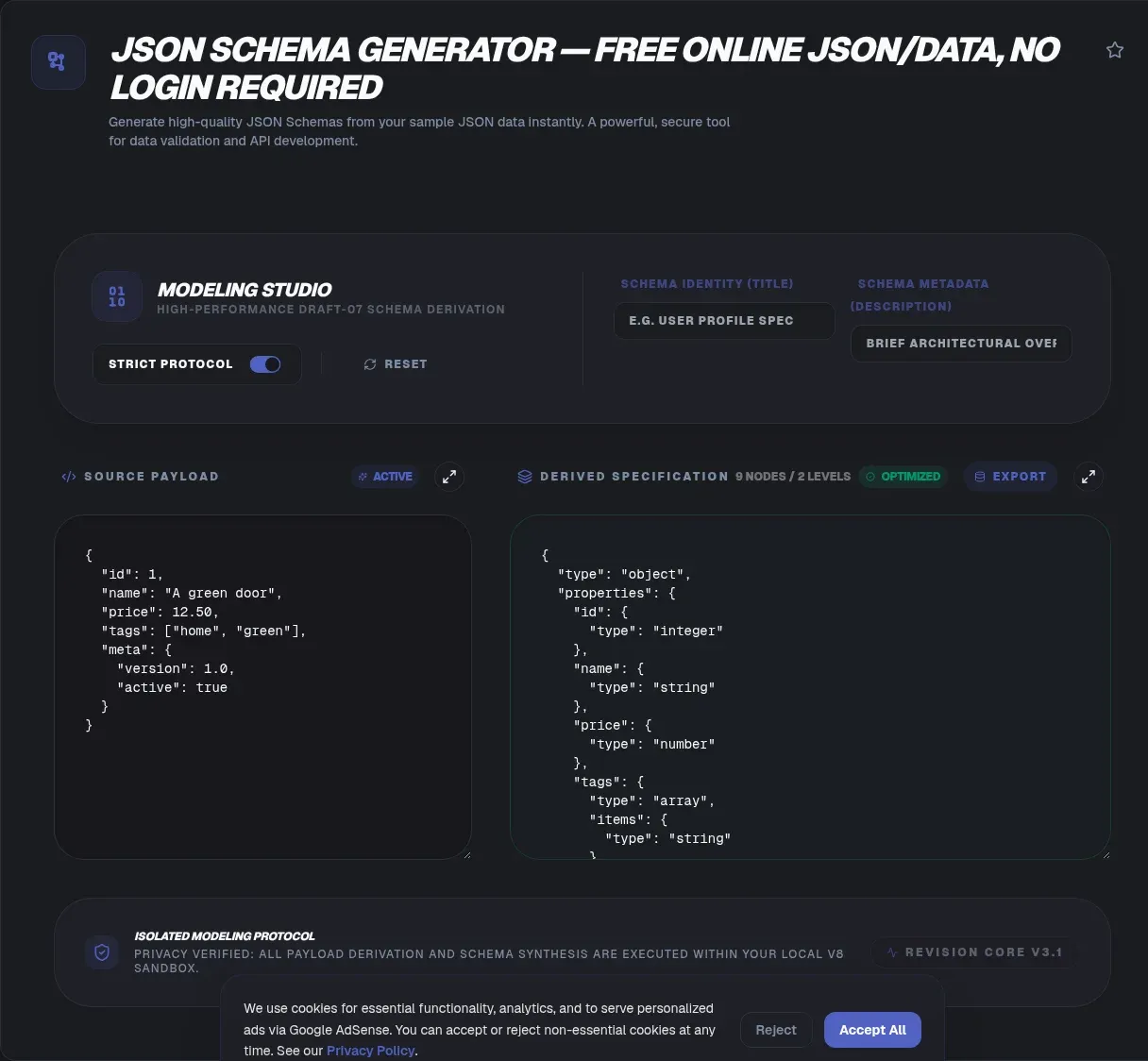
A JSON schema generator turns a pasted example into a reusable validation contract, and the ToolSura version does all of it in your browser. Paste a payload, choose a draft version, and get a structured schema with inferred types, required fields, and copy-ready output. Your sample never leaves your device: parsing happens locally in the tab, with no account, no install, and no setup.
That matters when payloads carry customer records, internal configuration, or unreleased product shapes, because your sample never leaves your device and nothing is uploaded at any point. Below, find what the tool produces, where automated inference falls short, and how to harden raw output into something a validator or CI pipeline can trust.
Key Takeaways
- Generated schemas are hypotheses: review every inferred type and required flag before treating them as contracts.
- Generation runs in your browser, so samples stay local.
- Draft 2020-12 fits new work; older tooling often needs Draft 7 or 4.
- format keywords annotate by default under 2020-12; enforcement is opt-in.
- Ajv logged 369M+ downloads in one Aug 2026 week (npm registry).
What Exactly Is a JSON Schema Generator?
A JSON schema generator inspects example JSON and emits a machine-readable blueprint of it: which properties exist, which types they hold, and which fields every object must include. That vocabulary has evolved in public ever since the first drafts appeared on December 5, 2009, according to the json-schema.org specification index.
Output follows a familiar shape. A $schema line pins the dialect, type declares whether the root is an object or an array, properties maps each key to constraints, and required lists the keys that must exist. Arrays carry an items rule describing their elements. One reviewed file then validates payloads, drives editor autocomplete, feeds documentation generators, and anchors codegen.
Why Generate a Schema Instead of Writing One by Hand?
Generation beats typing because real payloads nest deeply and drift constantly, and hand-authoring hundreds of properties invites mistakes. Some platforms remove the choice entirely: Kubernetes requires that CustomResourceDefinitions carry a structural schema under apiextensions.k8s.io/v1 (Kubernetes documentation). A good generator returns a complete first draft in seconds instead of an afternoon.
Treat generation as scaffolding rather than a finished building. The tool enumerates keys and types; you supply judgment about business rules, optionality, and strictness. Teams that treat the output as a starting point ship working contracts quickly. Teams that trust it blindly discover gaps the moment a partner submits unexpected data.
How Does a Browser-Based JSON Schema Generator Work?
Client-side generation parses your JSON with JavaScript inside the current tab, walks the tree, and infers a schema node for every value found. The ToolSura page documents a 100% client-side V8 sandbox architecture, so parsing and inference execute in the same engine that renders the page rather than on a remote server.
Practical consequences follow. Nothing to install means the tool opens instantly on any machine, including locked-down corporate laptops. There is no upload progress bar because no transfer occurs. Deterministic logic also means the identical sample produces identical output twice, which keeps regeneration predictable as your payloads evolve.
Is Your JSON Ever Uploaded During Generation?
For this tool, the answer per its own documentation is no: the tool page describes local processing with no storage and no logging. That claim is vendor documentation rather than an independent audit, so weigh it accordingly. Competing converters differ sharply, and their own pages say so.
The contrast is instructive. Liquid Technologies' online converter warns that 'all data is stored on our servers' and 'may be retained', steering sensitive work to its desktop edition (Liquid Technologies). quicktype, ExtendsClass, and Transform.tools leave their processing location unstated and make no privacy claim on their pages. When confidentiality matters, favor tools with documented models.
EU-context data adds a regulatory angle. GDPR Article 5(1)(c) requires personal data to be 'adequate, relevant and limited to what is necessary' (EUR-Lex, Regulation (EU) 2016/679). Pasting production payloads into server-side tools sits uneasily beside that principle. This is general information, not legal advice.
How Does ToolSura's Generator Compare With Other Online Tools?
Draft flexibility separates the field quickly. This generator supports Draft 4, Draft 7, and Draft 2020-12, while ExtendsClass publishes draft-07 output only and Liquid Technologies' online page shows no draft selector (ExtendsClass). If your validator or framework dictates a dialect, check version support before committing to any converter.
Documented features diverge too. Liquid Technologies exposes array-rule modes, enum inference, and make-required toggles, but its online edition caps uploads at 512Kb. quicktype generates typed code for 27 targets and suits code-first teams (quicktype). Transform.tools is a minimal two-panel conversion with no documented options (Transform.tools). None explains inference limits; this guide aims to.
Which JSON Schema Draft Version Should You Choose?
Pick Draft 2020-12 for new work: it is the current released specification, and its validation internet-draft was published December 8, 2020 (IETF Datatracker). Choose Draft 7 when older validators set the ceiling, and Draft 4 when legacy Swagger 2.0-era tooling consumes the file.
The lineage explains why old drafts persist. draft-03 arrived November 22, 2010, draft-04 on January 31, 2013, draft-06 on April 21, 2017, and draft-07 on March 19, 2018, with 2019-09 following on September 17, 2019, per the specification index. Enterprise frameworks freeze on whatever draft they shipped with, so multi-version support stays practical.
Is JSON Schema a Formal Standard?
No. JSON Schema has never been published as an ISO/IEC standard or an IETF RFC; every version through 2020-12 exists only as an Internet-Draft (json-schema.org). The accurate description is a widely adopted community specification, maintained in the open.
Governance has wandered too. An OpenJS Foundation hosting announcement landed January 31, 2022 (OpenJS Foundation), but json-schema.org later reported that onboarding 'was not able to be completed' and that the project 'is currently independent' (January 13, 2025). An Ecma International technical committee proposal opened August 18, 2025 (GitHub issue #1622); it remains a proposal only.
What Can Inference Actually Learn From One Sample?
Treat every generated schema as a hypothesis about your data, never as revealed truth. One sample proves only what that sample contains: fields absent from any observed object look optional, whole-number values suggest integers ambiguously, and null values erase type information completely. Human review is what converts plausible output into a dependable contract.
Sampling breadth changes the verdict. Three messy production payloads infer a looser, safer schema than one pristine fixture. Diff payload variants before generating, reconcile differences by hand, and expect edits. Mature teams commit the reviewed schema beside the code, then fail builds whenever payloads and contract drift apart.
Why Is Your Field Not Marked Required?
Inference demands unanimity: a property joins required only when it appears in every observed object, so a single record missing an address demotes that field to optional. The guide states the converse plainly: properties listed under properties alone constrain nothing (Understanding JSON Schema: objects).
Arrays amplify the effect. If nine elements carry a price key and the tenth omits it, the field lands as optional across the board. Whether that mirrors reality is a business call no algorithm can make. Review the inferred required list line by line, then promote fields your contract truly mandates.
What Is the Difference Between integer and number?
JSON itself carries a single number type, so the split lives entirely in the schema. The guide notes that 'JSON does not have separate types for integer and floating-point' values: type: number accepts both 42 and 42.0 while rejecting '42' as a string (Understanding JSON Schema: types).
Seven values exist for type: string, number, integer, boolean, object, array, and null. The trap is evidential, because a whole-number sample like 42 cannot reveal whether decimals belong. If prices can reach 42.50, change the inferred integer to number yourself. Small edits like that prevent embarrassing validation failures later.
What Happens When a Sample Value Is null?
Null quietly deletes evidence. A field sampled only as null gives the generator no clue about its underlying type, so output cannot distinguish a nullable string from an unknown shape. Expect such fields to need manual repair, usually by pairing the original type with null in a union.
Recent drafts express that union as a type array such as [string, null], while older dialects lean on anyOf. Either way the fix belongs to you. Scan generated output specifically for null-sampled fields before anything else; they are the likeliest silent defects in otherwise sound inference.
What Does additionalProperties Do in a Generated Schema?
Unknown keys pass by default. The object guide states that 'any additional properties are allowed' unless a schema forbids them (Understanding JSON Schema: objects), so generated output silently accepts supersets of your sample. Adding additionalProperties: false flips validation to strict rejection.
Decide deliberately instead of by reflex. Strict mode catches typos and rogue fields, which suits config files and public contracts. Lenient mode tolerates harmless additions from well-meaning clients, which suits evolving internal services. Whatever you choose, write it into team conventions, because mixed policies across repos cause baffling intermittent failures.
Are email and date-time Formats Actually Enforced?
Usually not, and assuming otherwise fails audits. Under Draft 2020-12, format is annotation-only by default: implementations collect it as documentation and format assertions 'MUST be disabled by default' (IETF Datatracker, section 7.2). A generated format: email therefore records intent until you switch enforcement on.
Ajv, the dominant JavaScript validator, also requires opting in before format strings bite. Change is planned, not shipped: json-schema.org's January 13, 2025 roadmap post says the next release will make format validate by default (json-schema.org blog). Until your validator adopts it, treat format hints as comments, not guards.
Where Do Generated Schemas Get Used in Real Projects?
Three ecosystems anchor daily use. OpenAPI 3.1.0, published February 15, 2021, defines its Schema Object as a superset of Draft 2020-12 (OpenAPI Specification), so clean output ports almost directly into API documents. Kubernetes CRDs require structural schemas, and countless CI pipelines gate merges on payload validation.
Editors round out the picture: YAML and JSON tooling consumes schemas to autocomplete keys, flag typos, and display inline descriptions. Documentation generators and mock-data producers read the same file. One artifact, four jobs, provided a human reviewed it first.
How Do You Validate JSON Against a Generated Schema?
Feed both artifacts to a validator: ToolSura's JSON Schema Validator in the browser, Ajv for JavaScript (Ajv documentation) or python-jsonschema for Python (project documentation). Scale here is enormous: Ajv recorded 369,779,194 downloads for the week of Aug 16-22, 2026, per the npm registry API.
Context matters for those numbers. Most volume is transitive: webpack declares schema-utils ^4.3.3, which declares ajv ^8.9.0, so millions arrive through build tooling rather than deliberate choice. The trailing-month window reached 1,498,405,207, reflecting the same dependency chain.
On the Python side, the jsonschema package showed 149,729,016 downloads in its last-week rolling window and 633,520,025 monthly, as served by pypistats.org on 2026-08-23; windows include heavy automated CI traffic (pypistats API). Either library validates your schema within minutes.
One security rule belongs in every plan: validation 'must be implemented on the server-side before any data is processed' because client-side checks 'can be circumvented' (OWASP Cheat Sheet Series). Client-side schema checks improve feedback loops; server-side checks protect systems. Run both.
How Should You Prepare Samples Before Generating a Schema?
Preparation determines output quality more than any setting. Start with syntactically clean JSON, gather several representative payloads including awkward optional fields, and swap placeholder identifiers for realistic ones. Ten minutes of curation routinely saves an hour of post-generation patching.
Run a consistent checklist. Lint syntax first, since a stray comma corrupts inference quietly. Give arrays several elements so item shapes register. Split mixed-type collections into positional rules (prefixItems under 2020-12) or unions (anyOf) afterward. Commit the finished schema to version control and review its diffs like code.
Final Checklist Before You Ship a Schema
Five checks separate a toy from a contract: confirm the draft matches your validator, review every required entry by hand, resolve null-sampled types, set an additionalProperties policy on purpose, and configure format assertions explicitly where patterns matter. Each takes minutes; skipping one invites a late-night incident.
Related Tools
These companion utilities, all free and browser-based, slot neatly around schema work:
- JSON Formatter and Validator: lint sample payloads before inference
- CSV to JSON Converter: convert spreadsheet exports into JSON first
- JSON Diff and Compare: compare payload variants your schema must cover
- JSON to YAML Converter: reshape schemas and configs for Kubernetes files
- UUID Generator: mint realistic identifiers for test payloads
- HTML Table Generator from CSV: publish sample datasets beside schema docs
When you are ready, open the ToolSura JSON Schema Generator, paste a sample, and turn today's payload into tomorrow's contract.